Advertisements
Advertisements
Question
Do you exercise regularly? If you do, which of the following activities do you prefer? Discuss and share with your partner a few ideas about your preference.
- walking
- working out in a gym
- swimming
- cycling
Advertisements
Solution
| A | I prefer walking. It is a wholesome exercise. Regular walk helps blood circulation very well. A brisk walk for an hour a day keeps one perfect fit. |
| B | I love swimming. I admire Michael Phelps for his achievement in swimming. When schools disowned him, his mom found out his interest in swimming. He turned out to be an Olympian of all time with 28 medals. One day I will win gold in swimming for India. |
| C | Well, after seeing Dipa Karmakar perform ‘Produnova vault at the summer Olympics in 2016,1 wish to become an expert in gymnastics |
| D | Well, I love cycling because it is pollution-free. I feel it gives a complete exercise. |
APPEARS IN
RELATED QUESTIONS
In what way is the poet relevant to our times?
Explain and discuss the themes of the poem.
Thus I entered, and thus I go!
In triumphs, people have dropped down dead,
"Paid by the world, what dost thou owe
Me? "....God might question; now instead,
'Tis God shall repay: I am safer so.
Read the above lines and amswer the question that follow.
Can one see the faith of humans in God in the poem?
Write a composition (350 - 400 words) on the following:
Write an original short story entitled 'The, Gift'.
Anil is too fast a runner not to come first in the race. (Begin: Anil is so………….)
Study the picture given below. Write a story or a description or an account of what it suggests to you. Your composition may be about the subject of the picture or you may take suggestions from it; however, there must be a clear connection between the picture and your composition.
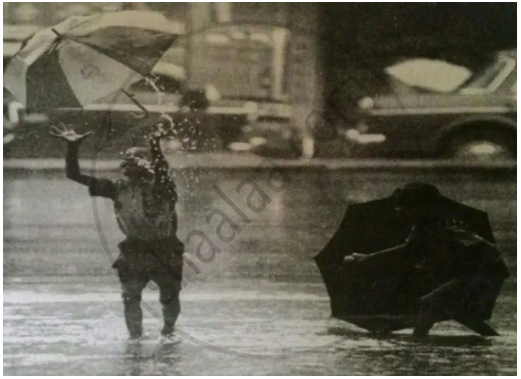
Fill in the blank with an appropriate word:
He was …….. pressure to complete the work.
They had to climb ____________the steep pathway to reach the top.
"We have had no rain since January", Ramu said.
(Begin: Ramu said that they .................. )
Notice the following sentence patterns.
Eternal I rise
Rewrite the above sentences in prose.
What was the underlying reason for John Ipe's disgust with the world?
Entomologist and lepidopterists are mentioned in the text and you must have guessed the meanings of these words or found them out in the dictionary.
Now match the kinds of scientists given with the work they do:
|
A |
B |
|
ornithologist |
study of the skin |
|
gerontologist |
study of cells |
|
ergonomist |
study of birds |
|
dermatologist |
study of old age |
|
cytologist |
study of the design of equipment |
See if you understand what the following words that are parts of a house mean. Look up the dictionary if you don't.
|
parlour |
foyer |
lounge |
porch |
|
lobby |
attic |
portico |
|
We add ‘un-’ to make opposites. For example, true — untrue. Add ‘un’– to the word below to make its opposite. Then look up the meaning of the word you have formed in the dictionary.
qualified: ____________
The word ‘round’ usually means a kind of shape. What is its meaning in the story?
Choose any novel/book that you enjoyed. Prepare a synopsis of the novel. It should include the major events and the links between them as described in the novel. You may prepare a chapter-wise outline first and then put the outlines together to write a brief synopsis.
Think and respond with ‘YES’ or ‘NO’.
When you are faced with a very serious problem or some grave danger, what do you experience?
| Your feelings | panic | |
| wishing you were never born | ||
| hopelessness | ||
| helplessness | ||
| no emotion | ||
| calmness and composure | ||
| willingness to tackle it | ||
| Your reactions | break down and cry | |
| run away and hide | ||
| pray to God | ||
| ask for help | ||
| build up courage | ||
| take it as a challenge |
Imagine the Stranger-man narrates how the Neolithic ladies overpowered him. Write an account of the same making him the narrator.
Answer the following question :
What are the advantages of an imaginary argument with a person having a different bias?
Look at the image of the familiar advertisement given below. Identify the product and try to frame your own slogan for them.

Now make one more question for each picture. Write the question in the space below each picture. Use how many, what are, where are/is, how, why, to make questions.
 |
 |
 |
 |
 |
 |
Match the two parts of sentences given under column ‘A’ and ‘B’. Add ‘but’ to join the two parts and write complete sentences.
| Column A | Column B |
| i). Helen lived after her illness | a). her mother thought she could learn. |
| ii). She could not see or hear | b). she did not understand what she was doing. |
| iii). People thought that she could not learn anything | c). she could not hear or see. |
| iv). Helen copied the words | d). she was kind to Helen. |
| v). Miss Sullivan was strict | e). she was very intelligent. |
Now group these activities into indoor and outdoor activities.
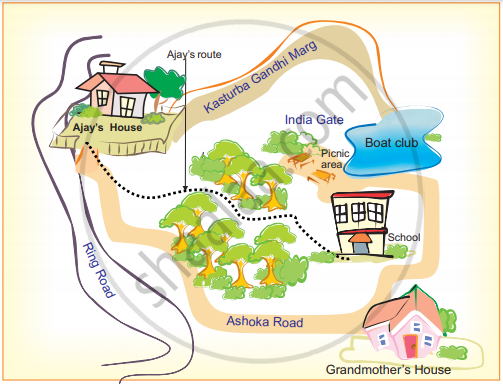
Use the above map to answer the questions.
- What does the dotted line on the map show?
- What road would Ajay take to get to the boat club?
- What building is next to the picnic area?
- What road passes by Ajay’s house?
- What other way could Ajay use to get from his house to his grandmother’s house?
Now write:
Use verbs like go, turn, cross
Use prepositions like: across, between, in front of, beside, near, behind, and write how you get home from school.
The hunter shot at the ______of birds.
The grandmother played a vital role in the author’s formative years. Give your own example of how elders have a positive influence on the younger generation. Include examples from the story also.
Why did Philip Sletherby visit Brill Manor?
Describe Bertie’s problem.
Write conversation on the following situation.
Between two friends on the benefits of early rising
Imagine someone has invited your family to a programme and you were the only person at home when the invitation was given orally.
Write a note (4-5 lines) to pass on the message to the other people in your family. Or, Write an imaginary conversation in which you pass on the message to your parents.
