Advertisements
Advertisements
Question
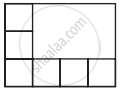
Divide the figure given alongside four parts in such a way that the area and shape of each part are the same. Colour the parts in different colours.

Advertisements
Solution

Explanation:
The given figure is correctly divided into four equal parts. Each part contains exactly 4 small squares, making the area equal. All parts have the same “L” shape, just rotated in different directions. The parts are also colored differently to show the division clearly.
Thus, both the area and shape of each part are the same, fulfilling the requirement of the question.
RELATED QUESTIONS
Find the area of a square park whose perimeter is 320 m.
The length of the side of the square is given below. Find its area.
6 cm
The length of the side of the square is given below. Find its area.
18 cm
The picture alongside shows some squares. Find out how many squares with the same measures will fit in the empty space in the figure.
The table given below contains some measures of the square. Find the unknown values.
| Side | Perimeter | Area |
| ? | ? | 49 sq.feet |
A square park has 40 m as its perimeter. What is the length of its side? Also find its area
its area is ____________ square cm.
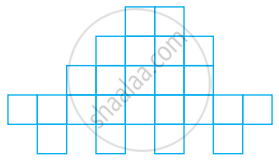
What is the area of each small square in the following figure. if the area of entire figure is 96 sq cm. Find the perimeter of the figure.
Architects design many types of buildings. They draw plans for houses, such as the plan shown in the following figure:
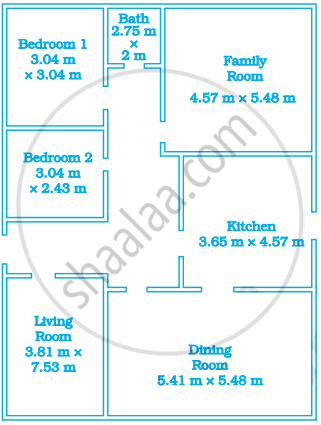
An architect wants to install a decorative moulding around the ceilings in all the rooms. The decorative moulding costs ₹ 500/metre.
- Find how much moulding will be needed for each room.
(i) family room
(ii) living room
(iii) dining room
(iv) bedroom 1
(v) bedroom 2 - The carpet costs ₹ 200/m2. Find the cost of carpeting each room.
- What is the total cost of moulding for all the five rooms.
Find the area of a square field with side 14 cm.
