Advertisements
Advertisements
Question
Distinguish between evaporation and transpiration.
Distinguish Between
Advertisements
Solution
| S.no. | Evaporation | Transpiration |
| 1. | The process in which the liquid form of water changes into a gaseous form. | The process by which the water content in the plant is released into the atmosphere in the form of water vapour. |
| 2. | The amount of water gets evaporated is about the same as the amount of water delivered to earth as precipitation. | The soil water content and the ability of the soil to conduct water the roots and the nature of the plant parts also determine the transpiration rate |
| 3. | The rate of evaporation is low during the periods of calm winds than during windy times. | The rate of transpiration is affected by temperature, wind, and humidity. |
shaalaa.com
Components of Hydrologic Cycle
Is there an error in this question or solution?
APPEARS IN
RELATED QUESTIONS
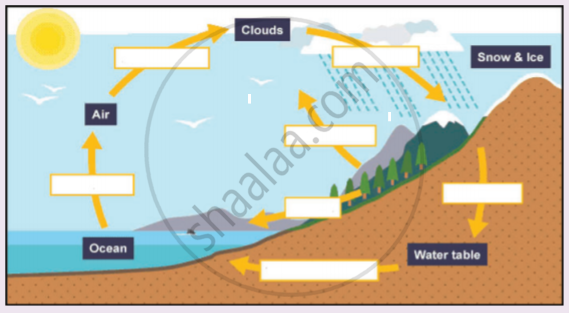
Find out the missing components of hydrologic cycle in the given diagram and fill it up appropriately.
Identify the element which is not a part of the hydrological cycle.
The process of change of water into gaseous form is called ______.
An air layer next to the earth’s surface to 1000 m or lower is called as ______.
The three important phases of the hydrologic cycle are ______, ______, and ______.
There is a ______ relationship between temperature and evaporation.
Rain is the tiny droplets of water hanging in the air.
What are the factors that increase the rate of evaporation?
For aviation purpose, the criterion for fog is ______ or less.
Where do condensation and saturation occur?
