Advertisements
Advertisements
Question
Discuss in detail the contributions of Morgan and Sturvant in the area of genetics.
Advertisements
Solution
Experimental verification of the chromosomal theory of inheritance by Thomas Hunt Morgan (Father of experimental genetics) and his colleagues, led to discovering the basis .for the variation that sexual reproduction produced. Morgan worked with the tiny fruit files, Drosophila melanogaster, which were found very suitable for such studies.
- Morgan carried out several dihybrid crosses in Drosophila to study genes that were sex-linked. The crosses were similar to the dihybrid crosses carried out by Mendel in peas. For example, Morgan hybridised yellow-bodied, white-eyed females to brown-bodied, red-eyed males and intercrossed their F, progeny.
- He observed that the two genes did not segregate independently of each other and the F2 ratio deviated very significantly from the. 9 : 3 : 3 : 1 ratio (expected when the two genes are independent). Morgan and his group knew that the genes were located on the X chromosome and saw quickly that when the two genes in a dihybrid cross were situated on the same chromosome, the proportion of parental gene combinations were much higher than the non-parental type.
- Morgan attributed this due to the physical association or linkage of the two genes and coined the term linkage to describe this physical association of genes on a chromosome and the term recombination to describe the generation of non-parental gene combinations.
- His student Alfred Sturtevant used the frequency of recombination between gene pairs on the same chromosome as a measure of the distance between genes and ‘mapped’ their position on the chromosome. Today genetic maps are extensively used as a starting point in the sequencing of whole genomes as was done in the case of the Human Genome Sequencing Project.
APPEARS IN
RELATED QUESTIONS
If centromere is situated in the middle of the chromosome, it is called ________.
(a) Metacentric
(b) Acrocentric
(c) Submetacentric
(d) Telocentric
Define the term ‘genome’.
A male honeybee has 16 chromosomes whereas its female has 32 chromosomes. Give one reason.
Who had proposed the chromosomal theory of inheritance?
Choose the correct options of the following question:
Study the given monohybrid cross:
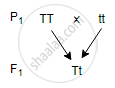
A test cross for this Fj will be:
Codon – anticodon interactions occur by
Identify the scientists who proposed chromosomal theory of inheritance.
Which of the following is a primary constriction?
During cell division, spindle fibres get attached to the disc shaped structures present on the centromere are known as ______.
Identify the term that represents the degree of repetition of the primary basic number of chromosomes in a cell.
At secondary constriction I, ______ becomes organized during interphase.
A gene pair hides the effect of another. The phenomenon is ______.
Which three scientists independently rediscovered Mendel’s work?
How many types of gametes would be produced if the genotype of a parent is AaBB?
Consider the following information and answer the question that follows:
|
Make a single pedigree chart using the above information to show the pattern of inheritance of phenylketonuria (PKU) in the family of Reshma.
Which chromosome in the human genome has the highest number of genes?
According to the Chromosomal Theory of Inheritance, what are the specific positions on chromosomes where genes are located called?
How many scientists independently rediscovered Mendel's laws of inheritance in the year 1900?
