English
Tamil Nadu Board of Secondary EducationHSC Science Class 12

Discuss about pile of plates. - Physics

Advertisements
Advertisements

Question

Discuss about pile of plates.

Answer in Brief
Advertisements

Solution

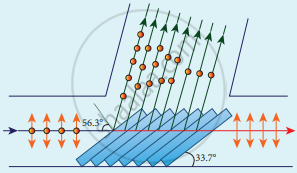
  1. The phenomenon of polarisation by reflection is used in the construction of pile of plates.
  2. It consists of a number of glass plates placed one over the other in a tube
  3. The plates are inclined at an angle of 33.7°(90° – 56.3°) to the axis of the tube. A beam of unpolarised light is allowed to fall on the pile of plates along the axis of the tube. So, the angle of incidence of light will be at 56.3° which is the polarising angle for glass.
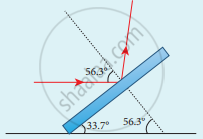
    Pile of plates
  4. The vibrations perpendicular to the plane of incidence are reflected at each surface and those parallel to it are transmitted.
  5. The larger the number of surfaces, the greater is the intensity of the reflected plane polarised light.
  6. The pile of plates is used as a polarizer and also as an analyser.
shaalaa.com
  Is there an error in this question or solution?
Chapter 7: Wave Optics - Evaluation [Page 103]

APPEARS IN

Samacheer Kalvi Physics - Volume 1 and 2 [English] Class 12 TN Board
Chapter 7 Wave Optics
Evaluation | Q 34. | Page 103

RELATED QUESTIONS

If the polarising angle for a given medium is 60°, then the refractive index of the medium is.................


What is a Polaroid?


Show, using a simple polaroid, that light waves are transverse in nature. Intensity of light coming out of a polaroid does not change irrespective of the orientation of the pass axis of the polaroid. Explain why.


How does one demonstrate, using a suitable diagram, that unpolarised light when passed through a Polaroid gets polarised?


Two polaroids P1 and P2 are placed with their pass axes perpendicular to each other. An unpolarised light of intensity I0 is incident on P1. A third polaroid P3 is kept in between P1 and P2 such that its pass axis makes an angle of 30° with that of P1. Determine the intensity of light transmitted through P1, P2 and P3


Show, via a suitable diagram, how unpolarised light can be polarised by reflection.


What is the Brewster angle for air to glass transition? (Refractive index of glass = 1.5)


When a low flying aircraft passes overhead, we sometimes notice a slight shaking of the picture on our TV screen. Suggest a possible explanation.


What is the value of refractive index of a medium of polarising angle 60°?


Show using a proper diagram how unpolarised light can be linearly polarised by reflection from a transparent glass surface.


What is the difference between polarised light and unpolarised light? 


Light transmitted by Nicol prism is ______.


What is unpolarised light?


List the uses of polaroids.


Polarisation of light is the only phenomenon that establishes ______.


Which of the following phenomena is not common to sound and light waves?


A polarizer - analyser set is adjusted such that the intensity of light coming out of the analyser is just 10% of the original intensity. Assuming that the polarizer - analyser set does not absorb any light, the angle by which the analyser need to be rotated further to reduce the output intensity to be zero, is ______.


Share
Notifications

Englishहिंदीमराठी


      Forgot password?
Use app×