Advertisements
Advertisements
प्रश्न
Discuss about pile of plates.
Advertisements
उत्तर
- The phenomenon of polarisation by reflection is used in the construction of pile of plates.
- It consists of a number of glass plates placed one over the other in a tube
- The plates are inclined at an angle of 33.7°(90° – 56.3°) to the axis of the tube. A beam of unpolarised light is allowed to fall on the pile of plates along the axis of the tube. So, the angle of incidence of light will be at 56.3° which is the polarising angle for glass.
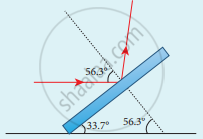
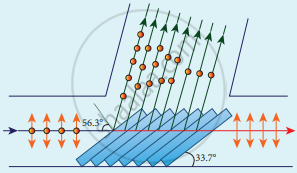
Pile of plates - The vibrations perpendicular to the plane of incidence are reflected at each surface and those parallel to it are transmitted.
- The larger the number of surfaces, the greater is the intensity of the reflected plane polarised light.
- The pile of plates is used as a polarizer and also as an analyser.
APPEARS IN
संबंधित प्रश्न
What is a Polaroid?
With the help of neat diagram, explain how non-polar dielectric material is polarised in external electric field of increasing intensity. Define polarisation in dielectrics.
If the critical angle of a medium is sin-1(3/5), find the polarising angle.
Show, using a simple polaroid, that light waves are transverse in nature. Intensity of light coming out of a polaroid does not change irrespective of the orientation of the pass axis of the polaroid. Explain why.
Find an expression for intensity of transmitted light when a polaroid sheet is rotated between two crossed polaroids. In which position of the polaroid sheet will the transmitted intensity be maximum?
Show, with the help of a diagram, how unpolarised sunlight gets polarised due to scattering.
Two polaroids P1 and P2 are placed with their pass axes perpendicular to each other. An unpolarised light of intensity Io is incident on P1. A third polaroid P3 is kept in between P1 and P2 such that its pass axis makes an angle of 45° with that of P1. Determine the intensity of light transmitted through P1, P2 and P3
State any two methods by which ordinary light can be polarised
Unpolarised light is incident on a polaroid. How would the intensity of transmitted light change when the polaroid is rotated?
Green light is incident at the polarising angle on a certain transparent medium. The angle of refraction is 30° . Find
(i) polarising angle, and
(ii) refractive index of the medium.
What is a polariser?
What is a analyser?
What is unpolarised light?
List the uses of polaroids.
State Brewster’s law.
Which of the following phenomena is not common to sound and light waves?
Can reflection result in plane polarised light if the light is incident on the interface from the side with higher refractive index?
Figure shown a two slit arrangement with a source which emits unpolarised light. P is a polariser with axis whose direction is not given. If I0 is the intensity of the principal maxima when no polariser is present, calculate in the present case, the intensity of the principal maxima as well as of the first minima.

To ensure almost 100 per cent transmissivity, photographic lenses are often coated with a thin layer of dielectric material. The refractive index of this material is intermediated between that of air and glass (which makes the optical element of the lens). A typically used dielectric film is MgF2 (n = 1.38). What should the thickness of the film be so that at the center of the visible spectrum (5500 Å) there is maximum transmission.
