Advertisements
Advertisements
Question
Differentiate between:
The middle ear and Inner ear.
Advertisements
Solution
| Middle Ear | Inner Ear |
| It has three ear ossicles and eustachian tube. | It has a cochlea, utriculus, sacculus, and semicircular canals. |
| It transmits sound vibrations. | It is concerned with hearing, balance, and equilibrium. |
RELATED QUESTIONS
Draw labelled diagrams of the following: Ear
Explain the following:
Mechanism through which a sound produces a nerve impulse in the inner ear.
find odd one from following: Malleus, iris, Stapes, Incus.
State the exact location of the Organ of Corti
There are three small bones in the muddle ear – anvil, hammer and stirrup :
(a) Which of these bones is in touch with ear-drum ?
(b) Which of these bones is in touch with oval window ?
The figure below is the sectional view of a part of the skull showing a sense organ:
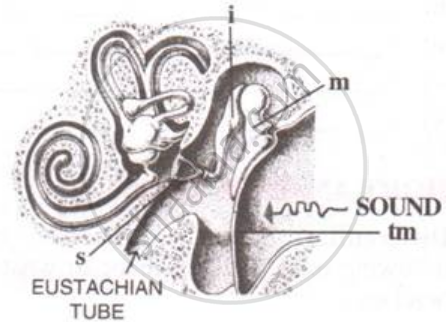
What are the parts labeled 'm', 'i' and 's'? What do these parts constitute collectively?
Given below is a diagram of a part of the human ear. Study the same and answer the question that follow:
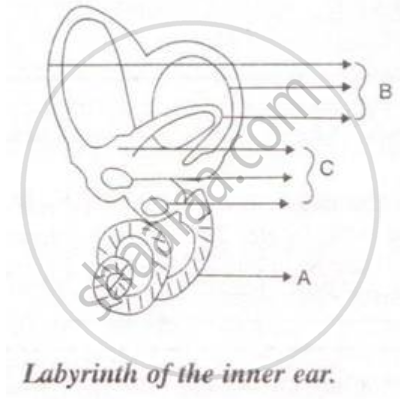
State the functions of the parts labeled 'A' and 'B'.
Given below is a diagram of a part of the human ear. Study the same and answer the question that follow:

Name the audio receptor region present in the part labeled 'A'.
Choose the Odd One Out:
With reference to human ear answer the question that follow:
Name the part of the ear associated with dynamic balance.
