Advertisements
Advertisements
Question
Differentiate between an artery and a vein with reference to lumen and thickness of wall.
Advertisements
Solution
| Artery | Vein | |
| 1. | The lumen is narrow. | The lumen is wide. |
| 2. | It is thick-walled. | It is thin-walled. |
APPEARS IN
RELATED QUESTIONS
Write the function of valves present in between atria and ventricles.
Write one structural difference between the composition of arteries and veins.
Differentiate between the following pair of terms:
RBC and WBC.
During surgical operations or during accidents, the patient may be given blood from outside to save his life. What is the technical name of this process ? Briefly explain the precautions to be observed and taken in this process.
Fill in the blank:
The blood vessels which carry blood from the heart to different parts of the body are called ________.
Find the odd one out, giving reason:
Arteries, capillaries, blood, veins
Name the instruments used for measuring blood pressure.
A muscular wall is absent in ______.
The figures given below are cross-sections of blood vessels.
(i) Identify the blood vessels A, B, and C.
(ii) Name the parts labeled 1-4.
(iii) Mention two structural differences between A and B.
(iv) Name the type of blood A that flows (a) through A, (b) through B.
(v) In which of the above vessels referred to in (iv) above does exchange of gases actually take place?
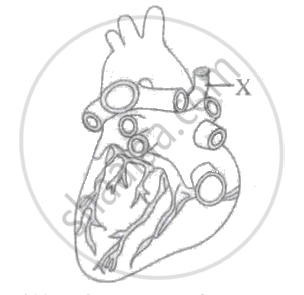
Which blood vessel is indicated by 'X' in the following diagram?