Advertisements
Advertisements
Question
Detennine the angle to be made with the vertical by a two wheeler rider while turning on a horizontal track.
Advertisements
Solution
When a bicyclist takes a turn along an unbanked road, the force of friction `vec f_s` provides the centripetal force; the normal reaction of the road `vec N` is vertically up. If the biker does not lean inward, the friction force will provide an uneven outward torque about the centre of gravity, fs.h, tipping the rider outward. The bicyclist must lean inward to counteract this torque (and not to generate a centripetal force) such that the opposite inward torque of the couple formed by `vec N` and the weight `vec g`, mg.a = fsh1.
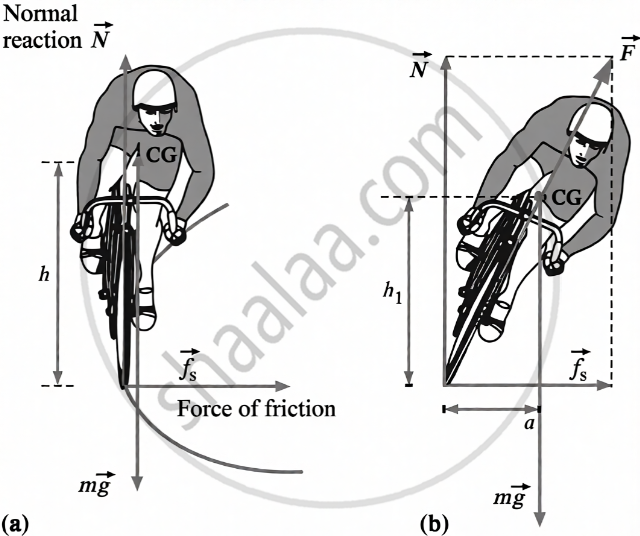
Since the force of friction provides the centripetal force,
Fs = `(mv^2)/r`
If the cyclist leans from the vertical by an angle θ, the angle between `vec N` and `vec F`.
tan θ = `f_s/N`
= `((mv^2)/r)/(mg)`
= `v^2/(gr)`
When an automobile makes a turn on a flat road, it may slide or roll outward due to the friction force. However, an automobile is elongated and has four wheels. When the inner wheels lift off the ground, a restoring torque from the couple formed by the outer wheels and the weight can counter it.
