Advertisements
Advertisements
Question
Describe the steps in breathing.
Answer in Brief
Advertisements
Solution
- Inspiration: During inspiration, the atmospheric air is taken into the lungs. It occurs due to the pressure gradient formed between the lungs and the atmosphere. It is an active process in which the diaphragm becomes flat and goes downward, the external intercostal muscles contract so the ribs and sternum move upward and outward. This leads to an increase in the thoracic volume and a decrease in the pressure of the thorax and the lungs. To equalize the low pressure inside the lungs, air from the atmosphere rushes into the lungs. This is an inspiration.
- Expiration: During expiration, the thorax contracts causing air to be exhaled. The diaphragm relaxes and is pushed upwards. It becomes dome-shaped. The intercostal muscles also relax pulling the rib cage inward and downward. This causes a decrease in thoracic volume and leads to an increase in pressure in the thorax and the lungs as compared to the atmospheric pressure. So air from the lungs rushes out. This is expiration.
shaalaa.com
Is there an error in this question or solution?
APPEARS IN
RELATED QUESTIONS
Answer briefly the following:
What is the difference between breathing and respiration?
Explain the mechanism of breathing.
Vital capacity is ______.
Resistance in the airways is typically low. Why? Give two reasons.
______ is formed when carbon monoxide combines with haemoglobin.
When you hold your breath, identify the gas changes that occur in blood and would first lead to the urge to breathe.
Explain the mechanism of breathing with neat labelled sketches.
What is phosphorylation?
What is Dead Space?
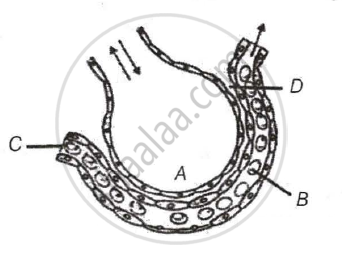
The figure given below shows a small part of human lung where exchange of gas takes place. In which one of the options given below, the one part A, B, C or D is correctly identified along with its function.