Advertisements
Advertisements
Question
Describe the process of fertilization.
Advertisements
Solution 1
Fertilization is the process which involves the fusion of the haploid male and female gametes resulting in the formation of a diploid zygote (2n). The process of fertilization is internal and it usually takes place in the ampulla of the fallopian/uterine tube. The fertilized egg or zygote further develops into an embryo within the uterus.
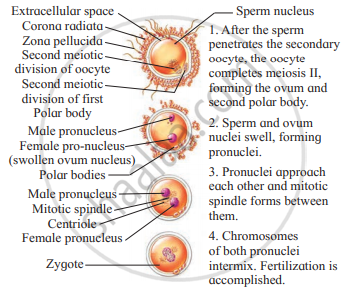
The mechanism of fertilization is as follows:
i. Movement of sperm towards egg: The ejaculated semen is made up of sperms and some other secretions. This coagulated semen undergoes liquefication and sperms become active. Once the sperms reach the vagina around 50% sperms are demobilized/broken/destroyed and the remaining sperms undergo capacitation.
- Capacitation: Capacitation generally requires 5-6 hours during which the acrosome membrane becomes thin, Ca++ enters the sperm, and sperm tails begin to show rapid whiplash movements. As a result of capacitation, sperms become extra active and begin to start moving upwards from the vagina to the uterus and to the oviducts. Prostaglandins activate the sperms. The vestibular secretions of the female also enhance sperms' motility. The sperms swim at an average speed of 1.5 to 3.0 mm/min and reach the ampulla. The contraction of the uterus and fallopian tubes stimulated by oxytocin of females also aids in the movement of sperm. After capacitation, the sperms may reach the ampulla within 5 minutes.
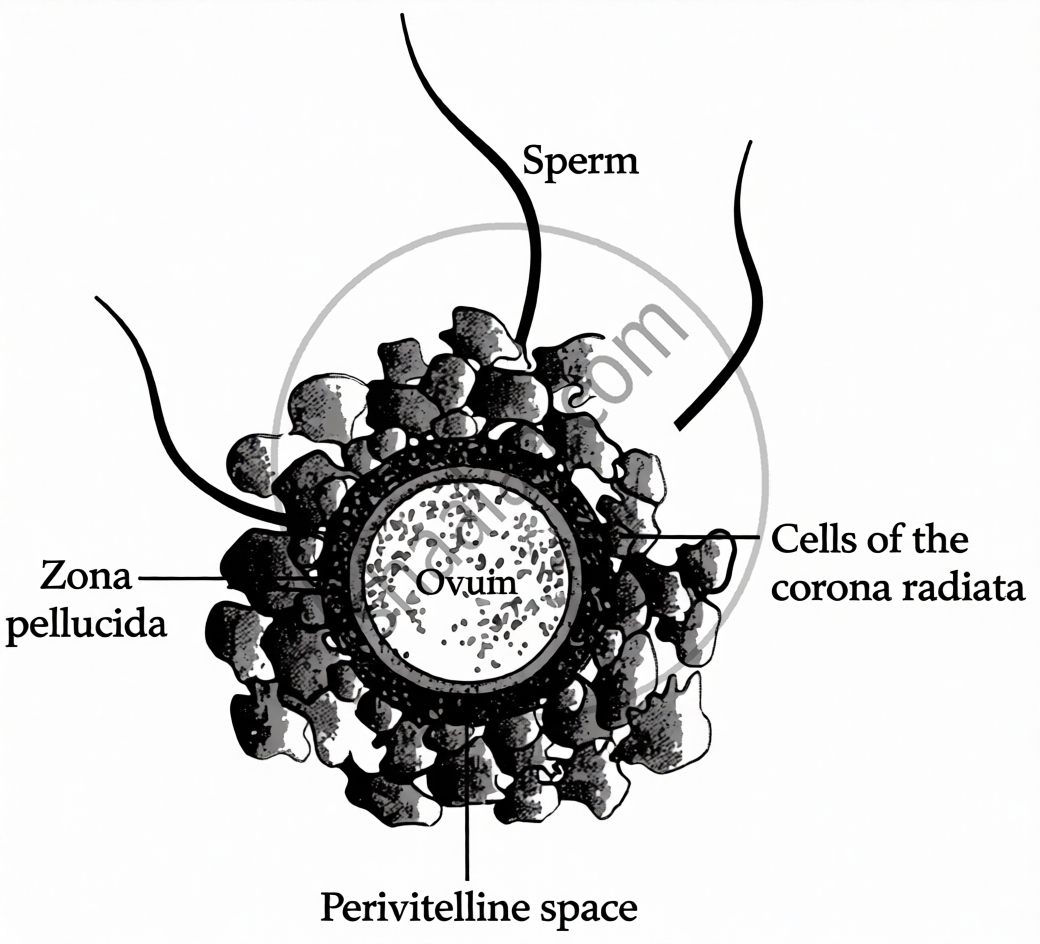
ii. Entry of sperm into the egg: Out of 200 to 400 million sperms, only few hundred manage to reach the ampulla, out of which only a single sperm fertilizes the ovum. After the sperm reaches the egg/ovum, its acrosome releases lysins: hyaluronidase and corona penetrating enzymes. These enzymes separate and dissolve the cells of corona radiata, so that the sperm head can pass through the zona pellucida of the egg. The zona pellucida has fertilizin receptor proteins (ZP3, ZP2). The fertilizin binds to specific acid protein- anti-fertilizin of sperm and brings about the attraction of sperms to the egg to enhance fertilization.
- Acrosome reaction: As the sperm head touches the zona pellucida in the animal pole region, its acrosome covering ruptures to release lytic enzymes, acrosin or zona lysin which act on the zona pellucida at the point of contact. This causes egg reaction during which a small fertilization cone/cone of reception is formed on the egg membrane. The sperm head comes in contact with this cone. It results in the production of a weak wave of depolarization. The plasma membrane of both cells dissolves at the point of contact.
The sperm nucleus and the centrioles enter the egg, while other parts remain outside.
As soon as the sperm head touches the vitelline membrane, a cortical reaction gets activated changing the vitelline membrane into a fertilization membrane by deactivating the sperm receptors of zona pellucida.
A distinct perivitelline space is created around the fertilization membrane.
This prevents any further entry of other sperms into the egg i.e. polyspermy is avoided.
iii. Activation of ovum: The ovum before fertilization was at metaphase II stage. After the contact of sperm head to the vitelline membrane of egg, it gets activated to resume and complete meiosis II. After meiosis II, the second polar body is formed. The germinal vesicle organizes into female pronucleus also known as the true ovum or egg.
- The fusion of egg and sperm: The coverings of male and female pronuclei degenerate, allowing the chromosomal pairing. This results in the formation of a synkaryon by the process called syngamy or karyogamy. The zygote is thus formed. The proximal centriole received from the sperm helps in the formation of the synkaryon spindle and cleavage of the cell into two blastomeres.
The zygote is thus formed.
The proximal centriole received from the sperm helps in the formation of the synkaryon spindle and cleavage of the cell into two blastomeres.
Solution 2
The sperm changes the zona pellucida during fertilization and prevents other sperms from entering. This avoids polyspermy and guarantees monospermy, in which only one sperm fertilizes the ovum.
The acrosome’s enzymatic secretion promotes the sperm’s entry into the ovum’s cytoplasm.
The secondary oocyte undergoes a second meiotic division as a result, producing a haploid ovum (ootid) and a secondary polar body. A diploid zygote is then created when the haploid sperm and ovum nuclei unite.
Notes
Students should refer to the answer according to their question and preferred amrks.
RELATED QUESTIONS
Define the term Gamete.
Define the Zygote.
The middle piece of sperm provides:
Given below is a portion of the diagram to show the diagrammatic highly magnified view of a single human sperm. Complete the diagram to show its normal structure.

State whether the following statement is true or false:
Gestation in humans is completed in about 380 days.
Rewrite the correct statement by changing the last one word if these statement is false.
Pregnancy in women can be prevented by the method of vasectomy.
Give appropriate term of the following:
The attachment of developing zygote (blastocyst) on the uterine wall.
Choose the correct answer:
Virgin birth is called ______________
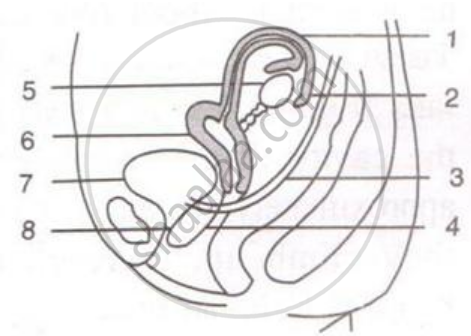
The following diagram represents the vertical sectional view of the human female reproductive system.
How does the uterus prepare for the reception of zygote?

The following diagram represents the vertical sectional view of the human female reproductive system.
What happens to the uterus, if fertilization fails to take place?
What are the functions of testes?
Write in sequence the regions in which a mature sperm travels from the seminiferous tubules up to the urethral opening?
What is fertilization? Name the site of fertilization in the human females.
Give Reasons
Gametes have a haploid (n) number of chromosomes.
Differentiate between tubectomy and vasectomy.
Explain the Term Vas deferens.
Give Technical Term:
What term is used for the production and maturation of sperms in the testes?
Complete the following sentences with appropriate word:
The process of releasing an egg from the ovary is called _________.
Mention, if the following statement is True or False. If false rewrite the wrong statement in its correct form:
Vas deferens transports sperms into the urethra.
Mention, if the following statement is True or False. If false rewrite the wrong statement in its correct form:
Fertilization is the product of the egg nucleus and the sperm nucleus.
Write the functional activity of the following structure:
Prostate gland
Explain the mechanism of fertilization in humans.
Which parts are converted into Seed and fruit respectively after fertilization?
Give scientific reason.
The new individual produced by sexual reproduction always has the recombined genes of both the parents.
In human beings, after fertilisation, the structure which gets embedded in the wall of uterus is
In markets, eggs of birds are available but never eggs of dogs. why?
State whether the following statement is True or False. If false, correct the statement:
The eggs of fish are covered by hard shells for protection.
What are the potential drawbacks in adoption of the IVF method?
- High fatality risk to mother.
- Expensive instruments and reagents.
- Husband/wife necessary for being donors.
- Less adoption of orphans.
- Not available in India.
- Possibility that the early embryo does not survive.
Choose the correct answer from the options given below:
