Describe the locus of a point in a rhombus ABCD which is equidistant from (i) AB and AD (ii) A and С.
Advertisements
Question
Describe the locus of a point in a rhombus ABCD which is equidistant from (i) AB and AD (ii) A and С.
Advertisements
Solution
(i) Equidistant from AB and AD: The locus is the diagonal AC.
A point equidistant from AB and AD lies on the bisector of ∠BAD. In a rhombus, each diagonal bisects the angles at the vertices it joins, so diagonal AC bisects ∠BAD. Inside the rhombus, the locus is therefore AC.
(ii) Equidistant from A and C: The locus is the diagonal BD.
A point equidistant from A and C lies on the perpendicular bisector of AC. The diagonals of a rhombus bisect each other at right angles, so diagonal BD is the perpendicular bisector of AC. Inside the rhombus, the locus is therefore BD.
The diagram follows.
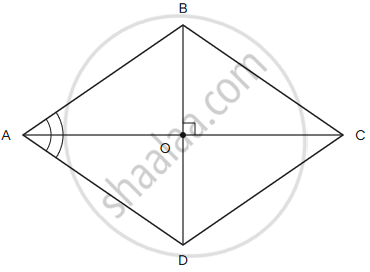
In the diagram, the arcs at A show that diagonal AC splits ∠BAD into two equal halves, so AC is the locus for (i). The right-angle mark at O shows that diagonal BD cuts AC at right angles through its mid-point O, so BD is the locus for (ii).
