Advertisements
Advertisements
Question
Describe the structure of phloem.
Advertisements
Solution
Phloem is made up of four types of cells :
1) Sieve tubes: These are tubular channels formed of elongated living cells, arranged in vertical rows.The transverse end walls are perforated with a number of pores (sieve plates). The cytoplasm of one element is continuous with the other through these pores. Nuclei are absent in sieve tubes.
2) Companion cells: These are small cells associated with sieve tubes, with dense cytoplasm and a large elongated nucleus. They remain connected to the sieve tubes by pores
3) Phloem parenchyma: These are simple delicate cells containing starch, tannin and crystals. These cells perform the function of storage and translocation of food substances.
4) Basil fibres: These are sclerenchymatous cells occurring in the phloem. They are composed of dead cells and function as storage tissue.
APPEARS IN
RELATED QUESTIONS
Why are the plants raised through micropropagation are termed as somaclones?
Mention two advantages of the micropropagation technique.
Explain the transpiration pull theory for an ascent of sap
Describe the tissue culture technique in plants.
You have obtained a high yielding variety of tomato. Name and explain the procedure that ensures retention of the desired characteristics repeatedly in large populations of future generations of the tomato crop.
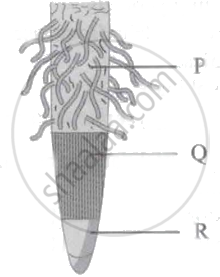
Identify labels P, Q, R in the given figure of root showing different regions.
Method of production of thousand of plant through tissue culture is ______.
Why is it easier to culture meristems compared to permanent tissues?
Write a short note on suspension culture.
What does the plant tissue culture medium consists of?
