Advertisements
Advertisements
Question
Describe one experiment to show that liquids expand on heating.
Advertisements
Solution
(i) Take an empty bottle with a tight-fitting cork having a hole drilled in its middle, a drinking straw, two bricks, a wire guaze and a burner.
(ii) Fill the bottle completely with water and add a few drops of ink in it to make it colored.
(iii) Fix the cork in the mouth of the bottle and pass the drinking straw through the cork. Put some molten wax around the hole so as to avoid the leakage of water.
(iv) Pour some more water into the drinking straw so that water level in the straw can be seen. Mark the water level in the straw as shown in the following figure.
Thermal expansion of a liquid

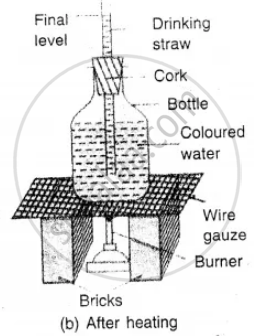
(v) Place the bottle on the wire gauze kept over the two bricks as shown in the following figure. Then heat the bottle by means of a burner.
(vi) Look at the level of water in the straw.
You will notice that as the water is heated more and more, the level of water in the drinking straw rises. This shows that water expands on heating.
APPEARS IN
RELATED QUESTIONS
Write true or false for a given statement.
All solids expand by the same amount when heated to the same rise in temperature.
Write true or false for a given statement.
Equal volumes of different liquids expand by different amounts when they are heated to the same rise in temperature.
Fill in the blank
Metals are _______ of heat.
The fig. shows a glass tumbler containing hot milk which is placed in a tub of cold water. State the direction in which heat will flow.

Name two substances which expand on heating.
Why is a tea kettle provided with an ebonite handle?
In summer, ice is kept wrapped in a gunny bag. Explain the reason.
Explain why the water pipes are covered with cotton during very cold weather.
When we heat them the force of attraction between the molecules decreases and the ice cubes become ______.
______ is greater for liquids than solids and it is maximum in gases.
