Advertisements
Advertisements
Question
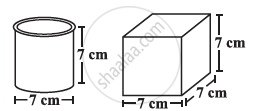
Describe how the two figures at the right are alike and how they are different. Which box has larger lateral surface area?
Advertisements
Solution
The first picture is of a cylinder.
Diameter of cylindrical box = 7 cm
Height of cylindrical box (h) = 7 cm
Then radius of cylindrical box (r) = 72 cm
Lateral surface area of cylindrical box = 2πrh
`= 2 × 22/7 × 7/2 × 7`
=154 cm2
And lateral surface area of the cubical box = 4× side2
= 4 × (7)2
= 196 cm2
Hence, it is clear that out of the lateral surface areas of the two, the lateral surface area of the cubical box is greater.
RELATED QUESTIONS
If each edge of a cube is doubled, how many times will its volume increase?
Find the volume of a cube whose side is 8 cm .
Suppose that there are two cubes, having edges 2 cm and 4 cm, respectively. Find the volumes V1and V2 of the cubes and compare them.
Find the surface area of a cube whose volume is 343 m3.
Find the length of 13.2 kg of copper wire of diameter 4 mm, when 1 cubic cm of copper weighs 8.4 gm.
Side of a cube is 4.5 cm. Find the surface area of all vertical faces and total surface area of the cube.
Find the T.S.A and L.S.A of the cube whose side is 8 m
Find the T.S.A and L.S.A of the cube whose side is 7.5 cm
The lateral surface area of a cube is 256 m2. The volume of the cube is ______.
A cube of side 5 cm is cut into as many 1 cm cubes as possible. What is the ratio of the surface area of the original cube to that of the sum of the surface areas of the smaller cubes?
