Advertisements
Advertisements
Question
Describe an experiment to show that sound cannot travel through vaccum.
Advertisements
Solution
- Aim:
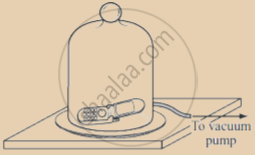
To prove that sound cannot travel through a vacuum and it needs a medium for propagation. - Materials Required:
Bell jar, mobile phone, and vacuum pump.
- Procedure:
- Take a bell jar and a mobile phone.
- Switch on the music on the mobile phone and place it in the jar.
- Now, pump out the air from the bell jar using a vacuum pump.
- As more and more air is removed from the jar, the sound from the mobile phone becomes feebler and finally, very faint.
- Conclusion:
This experiment proves that sound cannot travel in vacuum and it needs a medium.
APPEARS IN
RELATED QUESTIONS
Select the correct alternative :
Sound travels the fastest in
Describe an experiment to show that each source of sound is a vibrating body.
Describe an experiment to estimate the speed of sound in air.
The frequency of a source of sound is 100 Hz. How many times does it vibrate in a minute?
Can sound travel through (a) iron, and (b) water?
Name the device which is used to produce sound in laboratory experiments?
How does sound from a sound producing body travel through air to reach our ears? Illustrate your answer with the help of a labelled diagram.
Draw the sketches of two waves A and B such that wave A has twice the wavelength and half the amplitude of wave B.
Sound travels in the air if
______ is produced when an object is set to vibrate.
