Advertisements
Advertisements
Question
Derive the time period of the satellite orbiting the Earth.
Advertisements
Solution
Time period of the satellite: The distance covered by the satellite during one rotation in its orbit is equal to 2π (RE + h) and time taken for it is the time period, T. Then,
Speed, v = `"Distance travelled"/"Time taken" = (2π ("R"_"E" + "h"))/"T"` ..........(1)
Speed of the satellite, V = `sqrt("GM"_"E"/(("R"_"E" + "h")))`
`sqrt("GM"_"E"/(("R"_"E" + "h"))) = (2π ("R"_"E" + "h"))/"T"`
T = `(2π)/sqrt("GM"_"E") ("R"_"E" + "h")^(3/2)` ............(2)
Squaring both sides of the equation (2) we get,
T2 = `(4π^2)/"GM"_"E" ("R"_"E" + "h")^3`
`(4π^2)/"GM"_"E"` = constant say c
T2 = c(RE + h)3
Equation (3) implies that a satellite orbiting the Earth has the same relation between time and distance as that of Kepler’s law of planetary motion. For a satellite orbiting near the surface of the Earth, h is negligible compared to the radius of the Earth RE. Then,
T2 = `(4π^2)/"GM"_"E" "R"_"E"^3`
T2 = `(4π^2)/(("GM"_"E"/"R"_"E"^2)) "R"_"E"`
T2 = `(4π^2)/"g" "R"_"E"`
Since `"GM"_"E"/"R"_"E"^2` = g
T = `2π sqrt("R"_"E"/"g")`
By substituting the values of RE = 6.4 × 10⁶ m and g = 9.8 ms−2, the orbital time period is obtained as T ≅ 85 minutes.
APPEARS IN
RELATED QUESTIONS
The time period of a satellite orbiting Earth in a circular orbit is independent of
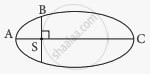
The kinetic energies of a planet in an elliptical orbit about the Sun, at positions A, B and C are KA, KB and KC respectively. AC is the major axis and SB is perpendicular to AC at the position of the Sun S as shown in the figure. Then
If a person moves from Chennai to Trichy, his weight _________.
What is meant by escape speed in the case of the Earth?
Define weight
Why is there no lunar eclipse and solar eclipse every month?
How will you prove that Earth itself is spinning?
In the following, what are the quantities which that are conserved?
If the Earth has no tilt, what happens to the seasons of the Earth?
Four particles, each of mass M and equidistant from each other, move along a circle of radius R under the action of their mutual gravitational attraction. Calculate the speed of each particle.
