Advertisements
Advertisements
Question
Explain in detail the idea of weightlessness using the lift as an example.
Advertisements
Solution
When a man is standing in the elevator, there are two forces acting on him.
1. Gravitational force which acts downward. If we take the vertical direction as a positive y-direction, the gravitational force acting on the man is `vec"F"_"G" = -"mg"hat"j"`
2. The normal force exerted by floor on the man which acts vertically upward, `vec"N" = "N"hat"j"`
The weightlessness of freely falling bodies: Freely falling objects experience only gravitational force. As they fall freely, they are not in contact with any surface (by neglecting air friction). The normal force acting on the object is zero. The downward acceleration is equal to the acceleration due to the gravity of the Earth, i.e., (a = g)
Newton’s second law acting on the man N = m(g – a)
a = g ∴ N = m(g – g) = 0.
APPEARS IN
RELATED QUESTIONS
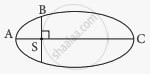
The kinetic energies of a planet in an elliptical orbit about the Sun, at positions A, B and C are KA, KB and KC respectively. AC is the major axis and SB is perpendicular to AC at the position of the Sun S as shown in the figure. Then
If a person moves from Chennai to Trichy, his weight _________.
The kinetic energy of the satellite orbiting around the Earth is __________.
What is meant by escape speed in the case of the Earth?
Why is the energy of a satellite (or any other planet) negative?
What are geostationary and polar satellites?
Define weight
Explain in detail the geostationary and polar satellites.
In the following, what are the quantities which that are conserved?
Four particles, each of mass M and equidistant from each other, move along a circle of radius R under the action of their mutual gravitational attraction. Calculate the speed of each particle.
