Advertisements
Advertisements
Question
Define the following term:
Peristalsis
Advertisements
Solution
Peristalsis is the rhythmic contraction and relaxation of the muscles of the alimentary canal that pushes the food along the gut.
APPEARS IN
RELATED QUESTIONS
What is the location and function of the villi?
Which part of the digestive canal is involved in:
Chewing of food ______.
What substances are contained in gastric juice? What are their functions?
Why is there no enzyme to digest vitamins?
Study the Following Dental Formula and Then Answer the Question that Follow:
`"i" 3/4 "c" 0/0 "pm" 0/1 "m" 1/1`
Give the dental formula of an adult human being.
Write the function of the following in the human alimentary canal:
Bile juice
Define the following term:
Digestion
Fill in the blank.
Steapsin is also called _________
Differentiate between
Digestion and Absorption
Answer in detail.
Name the four types of teeth and their functions
Give a reason.
Food becomes acidic in the stomach.
Which systems work together to provide the body with energy?
Write any two functions of digestive system.
Match the two columns and select correct option.
| Column - I | Column - II | ||
| i. | Sphincter of Oddi | a. | Oesophagus and stomach |
| ii. |
Ileo-caecal sphincter |
b. | Stomach and small intestine |
| iii. | Pyloric sphincter | c | Ileum and caecum |
| iv. |
Gastro-oesophageal sphincter |
d. | Opening of hepato- pancreatic duct |
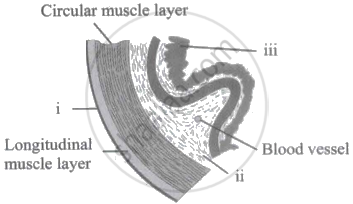
In the given histology of the alimentary canal, identify i, ii, and iii.
In which part of the alimentary canal food is finally digested?
Salivary glands secrete ______.
In which part of the alimentary canal food is finally digested?
Given below are two columns, Column I shows enzymes secreted by the glands in the alimentary canal of human beings and Column II indicates the components of food on which enzymes act. Choose the options showing correct matching:
