Advertisements
Advertisements
Question
Define the following:
Law of conservation of energy
Advertisements
Solution
The law of conservation of energy states that energy can neither be created nor destroyed. It may be transformed from one form to another but the total energy of an isolated system remains constant.
APPEARS IN
RELATED QUESTIONS
SPIC is located in
Explain the various sources of energy in Tamil Nadu.
A uniform force of `(2hati + hatj)` N acts on a particle of mass 1 kg. The particle displaces from position `(3hatj + hatk)` m to `(5hati + 3hatj)` m. The work done by the force on the particle is ______
A ball of mass 1 kg and another of mass 2 kg are dropped from a tall building whose height is 80 m. After, a fall of 40 m each towards Earth, their respective kinetic energies will be in the ratio of ______
A body of mass 4 m is lying in xy-plane at rest. It suddenly explodes into three pieces. Two pieces each of mass m move perpendicular to each other with equal speed v. The total kinetic energy generated due to explosion is ______
The potential energy of a system increases, if work is done ______
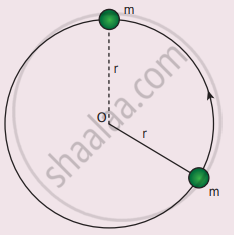
A bob of mass m is attached to one end of the rod of negligible mass and length r, the other end of which is pivoted freely at a fixed center O as shown in the figure. What initial speed must be given to the object to reach the top of the circle? (Hint: Use law of conservation of energy). Is this speed less or greater than the speed obtained in section 4.2.9?
Which of the following statements is true for commercial sources of energy?
______ with the healing power of nature as it assumes that all healing powers are within our body.
The ______ is usually instituted via law and is typically applied to necessary goods like food, rent, and energy sources in order to ensure that everyone has access to them.
