Advertisements
Advertisements
Question
Define one calorie.
Advertisements
Solution
One calorie is the amount of heat energy required to raise the temperature of 1 gram of water through 1°C.
RELATED QUESTIONS
Define the term heat.
Define the term calorie. How is it related to joule (the S.I. unit of heat)?
If objects of equal masses are given equal heat, their final temperature will be different. This is due to difference in their ______.
What will absorb heat?
Wax
What will absorb heat?
Glass vessel
Write scientific reason.
In the cold regions, snow falls in winter.
The unit of heat is
Which of the following substances will absorb more heat energy?
Ice is kept in a double-walled container. Why?
We reduce the heat by adding ______ while preparing fruit juice.
We feel the heat on our body when the ______ shines.
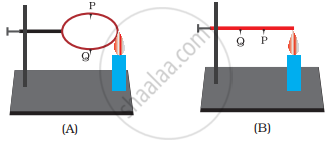
In the arrangements A and B shown in the following figure, pins P and Q are fixed to a metal loop and an iron rod with the help of wax. In which case are both the pins likely to fall at different times? Explain.
The water in the black can becomes ______ than that in a white can after exposure to the sun.
Black color is a ______ absorber of heat.
In summer, we prefer light – colored clothes and in winter we usually wear dark – colored clothes.
Match the following
| 1. | Heat | a. | Good absorber |
| 2. | Temperature | b. | Form of energy |
| 3. | Black surface | c. | Insulators |
| 4. | Rubber, cork | d. | The measure of hotness or coldness |
In which of the following, chemical energy is converted into heat energy?
Warm air is ______.
