Advertisements
Advertisements
Question
Deduce the expressions for the kinetic energy and potential energy of a particle executing S.H.M. Hence obtain the expression for the total energy of a particle performing S.H.M and show that the total energy is conserved. State the factors on which total energy depends.
Advertisements
Solution
Consider a particle of mass m performing linear S.H.M. with amplitude A. The restoring force acting on the particle is F = −kx, where k is the force constant and x is the displacement of the particle from its mean position.
(1) Kinetic energy: At distance x from the mean position, the velocity is
v = ω `sqrt("A"^2-"x"^2)`
where ω = `sqrt("k"//"m")`. The kinetic energy (KE) of the particle is
KE = `1/2`mv2 = `1/2` mω2(A2 − x2)
= `1/2`k(A2 − x2) ...........(1)
If the phase of the particle at an instant t is θ = ωt + x, where a is the initial phase, its velocity at that instant is
v = ωA cos (ωt + x)
and its KE at that instant is
KE = `1/2`mv2 = `1/2`mω2A2 cos2(ωt + x) ....(2)
Therefore, the KE varies with time as cos2θ.
(2) Potential energy: Consider a particle of mass m, performing a linear S.H.M. along the path MN about the mean position O. At a given instant, let the particle be at P, at a distance x from O.
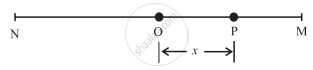 Potential energy of a particle in SHM
The corresponding work done by the external agent will be dW = ( - F)dx =kx dx. This work done is stored in the form of potential energy. The potential energy (PE) of the particle when its displacement from the mean position is x can be found by integrating the above expression from 0 to x.
∴ PE = `∫"dW"=∫_0^"x""kx dx"=1/2`kx2 ............(3)
The displacement of the particle at an instant t being
x = A sin (ωt + x)
its PE at that instant is
PE = `1/2`kx2 = `1/2`kA2 sin2(ωt + x) ............(4)
Therefore, the PE varies with time as sin2θ
(3) Total energy: The total energy of the particle is equal to the sum of its potential energy and kinetic energy.
From Eqs. (1) and (2), total energy is
E = PE + KE
= `1/2`kx2 + `1/2`k (A2 − x2)
= `1/2`kx2 + `1/2`kA2 −`1/2`kx2
∴ E = `1/2`kA2 = `1/2`mω2A2 ......(5)
As m is constant, and w and A are constants of motion, the particle's total energy remains constant (or is conserved).
APPEARS IN
RELATED QUESTIONS
The total energy of a body of mass 2 kg performing S.H.M. is 40 J. Find its speed while crossing the center of the path.
At what distance from the mean position is the speed of a particle performing S.H.M. half its maximum speed. Given the path length of S.H.M. = 10 cm.
When the displacement of a simple harmonic oscillator is half of its amplitude, its P.E. is 3 J. Its total energy is ______
Deduce the expression for kinetic energy, potential energy, and total energy of a particle performing S.H.M. State the factors on which total energy depends.
The quantity which does not vary periodically for a particle performing SHM is ______.
The displacement of a particle performing S.H.M. is given by x = 10 sin (`omega"t"+ alpha`) metre. If the displacement of the particle is 5 m, then the phase of S.H.M. is ____________.
The total energy of a simple harmonic oscillator is proportional to ______.
The ratio of kinetic energy to the potential energy of a particle executing S.H.M. at a distance equal to (1/3)rd of its amplitude is ______.
The kinetic energy of a particle performing S.H.M. is `1/n` times its potential energy. If the amplitude of S.H.M. is 'A', then the displacement of the particle will be ______
A body oscillates simply harmonically with a period of 2 seconds, starting from the origin. Its kinetic energy will be 75% of the total energy after time ______
`(sin30^circ = cos60^circ = 1/2)`
A particle starting from the mean position performs linear S.H.M. Its amplitude is 'A' and total energy is 'E'. At what displacement its kinetic energy is 3E/4?
A simple pendulum of length 'L' has mass 'm' and it oscillates freely with amplitude 'A'. At the extreme position, its potential energy is ______
(g = acceleration due to gravity)
The total energy of a particle performing S.H.M. is 'NOT' proportional to ______
The potential energy of a particle executing S.H.M is 2.5 J, when its displacement is half of amplitude. The total energy of the particle is ______.
A particle starts from mean position and performs S.H.M. with period 6 second. At what time its kinetic energy is 50% of total energy?
`(cos45^circ=1/sqrt2)`
A particle performs S.H.M. Its potential energies are 'U1' and 'U2' at displacements 'x1' and 'x2' respectively. At displacement (x1 + x2), its potential energy 'U' is ______.
A particle performs S.H.M. of period 24 s. Three second after passing through the mean position it acquires a velocity of 2 π m/s. Its path length is ______.
`(sin45^circ=cos45^circ=1/sqrt2)`
A particle starts oscillating simple harmonically from its equilibrium position with time period T. At time t = T/12, the ratio of its kinetic energy to potential energy is ______.
`[sin pi/3 = cos pi/6 = sqrt3/2, sin pi/6 = cos pi/3 = 1/2]`
A simple harmonic oscillator has amplitude A, angular velocity ω and mass m. Then, average energy in one time period will be ______.
A body of mass 0.5 kg performs SHM with amplitude 3 cm and force constant 10 N/m. Find its total energy.
When a longitudinal wave propagates through a medium, the particles of the medium execute simple harmonic oscillations about their mean positions. These oscillations of a particle are characterised by an invariant ______.
A particle is executing Simple Harmonic Motion (SHM). The ratio of potential energy and kinetic energy of the particle when its displacement is half of its amplitude will be ______.
A body attached to a spring oscillates in horizontal plane with frequency ‘n’. Its total energy is ‘E’ and the spring constant is ‘K’ then the velocity in the mean position is ______.
