Advertisements
Advertisements
प्रश्न
Deduce the expressions for the kinetic energy and potential energy of a particle executing S.H.M. Hence obtain the expression for the total energy of a particle performing S.H.M and show that the total energy is conserved. State the factors on which total energy depends.
Advertisements
उत्तर
Consider a particle of mass m performing linear S.H.M. with amplitude A. The restoring force acting on the particle is F = −kx, where k is the force constant and x is the displacement of the particle from its mean position.
(1) Kinetic energy: At distance x from the mean position, the velocity is
v = ω `sqrt("A"^2-"x"^2)`
where ω = `sqrt("k"//"m")`. The kinetic energy (KE) of the particle is
KE = `1/2`mv2 = `1/2` mω2(A2 − x2)
= `1/2`k(A2 − x2) ...........(1)
If the phase of the particle at an instant t is θ = ωt + x, where a is the initial phase, its velocity at that instant is
v = ωA cos (ωt + x)
and its KE at that instant is
KE = `1/2`mv2 = `1/2`mω2A2 cos2(ωt + x) ....(2)
Therefore, the KE varies with time as cos2θ.
(2) Potential energy: Consider a particle of mass m, performing a linear S.H.M. along the path MN about the mean position O. At a given instant, let the particle be at P, at a distance x from O.
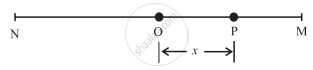 Potential energy of a particle in SHM
The corresponding work done by the external agent will be dW = ( - F)dx =kx dx. This work done is stored in the form of potential energy. The potential energy (PE) of the particle when its displacement from the mean position is x can be found by integrating the above expression from 0 to x.
∴ PE = `∫"dW"=∫_0^"x""kx dx"=1/2`kx2 ............(3)
The displacement of the particle at an instant t being
x = A sin (ωt + x)
its PE at that instant is
PE = `1/2`kx2 = `1/2`kA2 sin2(ωt + x) ............(4)
Therefore, the PE varies with time as sin2θ
(3) Total energy: The total energy of the particle is equal to the sum of its potential energy and kinetic energy.
From Eqs. (1) and (2), total energy is
E = PE + KE
= `1/2`kx2 + `1/2`k (A2 − x2)
= `1/2`kx2 + `1/2`kA2 −`1/2`kx2
∴ E = `1/2`kA2 = `1/2`mω2A2 ......(5)
As m is constant, and w and A are constants of motion, the particle's total energy remains constant (or is conserved).
APPEARS IN
संबंधित प्रश्न
The total energy of a body of mass 2 kg performing S.H.M. is 40 J. Find its speed while crossing the center of the path.
When the displacement of a simple harmonic oscillator is half of its amplitude, its P.E. is 3 J. Its total energy is ______
Deduce the expression for kinetic energy, potential energy, and total energy of a particle performing S.H.M. State the factors on which total energy depends.
The kinetic energy of a particle, executing SHM is 16 J, when it is in its mean position. If the amplitude of oscillation is 25 cm and the mass of the particle is 5.12 kg, the time period of its oscillation is ____________.
The displacement of a particle performing S.H.M. is given by x = 10 sin (`omega"t"+ alpha`) metre. If the displacement of the particle is 5 m, then the phase of S.H.M. is ____________.
The total energy of a simple harmonic oscillator is proportional to ______.
The ratio of kinetic energy to the potential energy of a particle executing S.H.M. at a distance equal to (1/3)rd of its amplitude is ______.
The kinetic energy of a particle performing S.H.M. is `1/n` times its potential energy. If the amplitude of S.H.M. is 'A', then the displacement of the particle will be ______
A body oscillates simply harmonically with a period of 2 seconds, starting from the origin. Its kinetic energy will be 75% of the total energy after time ______
`(sin30^circ = cos60^circ = 1/2)`
A particle starting from the mean position performs linear S.H.M. Its amplitude is 'A' and total energy is 'E'. At what displacement its kinetic energy is 3E/4?
The potential energy of a particle executing S.H.M is 2.5 J, when its displacement is half of amplitude. The total energy of the particle is ______.
Two springs of spring constants 'K' and '2K' are stretched by same force. If 'E1' and 'E2' are the potential energies stored in them respectively, then ______.
A particle performs S.H.M. Its potential energies are 'U1' and 'U2' at displacements 'x1' and 'x2' respectively. At displacement (x1 + x2), its potential energy 'U' is ______.
A particle performs S.H.M. of period 24 s. Three second after passing through the mean position it acquires a velocity of 2 π m/s. Its path length is ______.
`(sin45^circ=cos45^circ=1/sqrt2)`
A particle starts oscillating simple harmonically from its equilibrium position with time period T. At time t = T/12, the ratio of its kinetic energy to potential energy is ______.
`[sin pi/3 = cos pi/6 = sqrt3/2, sin pi/6 = cos pi/3 = 1/2]`
A simple harmonic oscillator has amplitude A, angular velocity ω and mass m. Then, average energy in one time period will be ______.
A body of mass 0.5 kg performs SHM with amplitude 3 cm and force constant 10 N/m. Find its total energy.
When a longitudinal wave propagates through a medium, the particles of the medium execute simple harmonic oscillations about their mean positions. These oscillations of a particle are characterised by an invariant ______.
A particle is executing Simple Harmonic Motion (SHM). The ratio of potential energy and kinetic energy of the particle when its displacement is half of its amplitude will be ______.
A particle of mass ‘m’ is executing S.H.M. about the origin on x-axis with frequencу `sqrt ((k a)/(pi m))`, where ‘k’ is a constant and ‘a’ is the amplitude of S.H.M. If ‘x’ is a displacement of a particle, at time ‘t’, potential energy of the particle will be ______.
A body attached to a spring oscillates in horizontal plane with frequency ‘n’. Its total energy is ‘E’ and the spring constant is ‘K’ then the velocity in the mean position is ______.
