Advertisements
Advertisements
Question
Convert 20 m/s into km/hr.
Advertisements
Solution 1
20m/s can be converted into km/hr as
20 m/s = `(20 xx 3600)/1000` = 72 km/hr.
Solution 2
`(1"m")/(1"s") = (10^(-3) "km")/(1/3600 "hr")`
= `(1/(1000))/(1/(3600)) "km"/"hr"`
= `(3600)/(1000)`
= 3.6 km/hr
1 m/s = 3.6 km/hr
20 m/s = 20 × 3.6 km/hr
= 72.0 km/hr
= 72 km/hr
APPEARS IN
RELATED QUESTIONS
If a body traverses a distance in direct proportion to the time, the speed of the body is ______.
Which is greater?
(i) 36 km/hr
(ii) 8.5 m/s
A quantity is measured to be -30 m/s. Is it speed or velocity?
For a body moving along a circular path, show that:
Linear speed = Angular velocity X radius of the circle
A body covers half the distance with the speed A and the other half with speed B. What will be the average speed for the whole journey?
In figure the position of a body times is shown . Calculate the speed of the body as it moves from 0 to A, A to B, B to C and i ts average speed .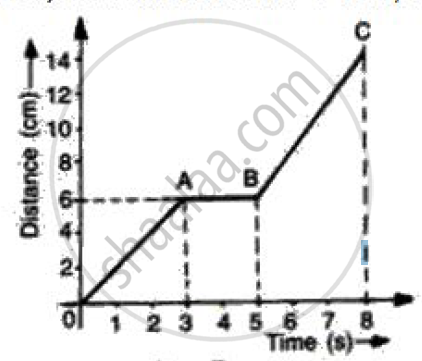
The correct relation among the following is
Usain Bolt crossed 100 meters in ______ seconds and made a world record.
Paheli and Boojho have to cover different distances to reach their school but they take the same time to reach the school. What can you say about their speed?
Abus from Chennai travels to Trichy passes loo km, 160 km at 10.15 am, 11.15 am respectively. Find the average speed of the bus during 10.15 – 11.15 am.
