Advertisements
Advertisements
Question
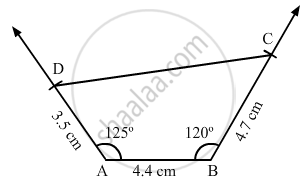
Construct a quadrilateral ABCD, in which AD = 3.5 cm, AB = 4.4 cm, BC = 4.7 cm, ∠A = 125° and ∠B= 120°.
Advertisements
Solution
Steps of construction:
Step I: Draw AB = 4 . 4 cm .
Step II: Construct \angleBAD = 125\textdegree at A .
Step III : With A as the centre and radius 3 . 5 cm, cut off AD = 3 . 5 cm .
Step IV: Construct ∠ABC = 120° at B .
Step V : With B as the centre and radius 4 . 7 cm, cut off BC = 4 . 7 cm .
Step VI: Join CD .
The quadrilateral so obtained is the required quadrilateral .
RELATED QUESTIONS
Construct the following quadrilaterals.
Quadrilateral MORE
MO = 6 cm
OR = 4.5 cm
∠M = 60°
∠O = 105°
∠R = 105°
Construct the following quadrilaterals.
Quadrilateral PLAN
PL = 4 cm
LA = 6.5 cm
∠P = 90°
∠A = 110°
∠N = 85°
Construct a quadrilateral ABCD in which AB = 3.8 cm, BC = 3.0 cm, AD = 2.3 cm, AC = 4.5 cm and BD = 3.8 cm.
Construct a quadrilateral ABCD in which AB = BC = 3 cm, AD = CD = 5 cm, and ∠B = 120°.
Construct a quadrilateral ABCD, where AB = 4.2 cm, BC = 3.6 cm, CD = 4.8 cm, ∠B = 30° and ∠C = 150°.
Construct a quadrilateral BDEF, where DE = 4.5 cm, EF = 3.5 cm, FB = 6.5 cm, ∠F = 50° and ∠E = 100°.
Construct a quadrilateral PQRS, where PQ = 3.5 cm, QR = 6.5 cm, ∠P = ∠R = 105° and ∠S = 75°.
To construct a unique parallelogram, the minimum number of measurements required is ______.
______ measurements can determine a quadrilateral uniquely.
Is it possible to construct a quadrilateral ROAM in which RO = 4 cm, OA = 5 cm, ∠O = 120°, ∠R = 105° and ∠A = 135°? If not, why?
