Advertisements
Advertisements
Question
Construct a trapezium ABCD where AB || CD, AD = BC = 3.2 cm, AB = 6.4 cm and CD = 9.6 cm. Measure ∠B and ∠A.
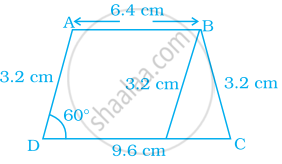
[Hint: Difference of two parallel sides gives an equilateral triangle.]
Advertisements
Solution
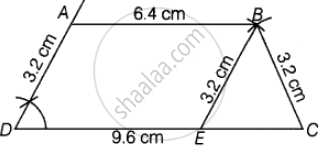
Steps of construction:
Step I: Draw a line segment DC = 9.6 cm.
Step II: With D as centre, draw an angle measure 60°. Now, cut-off it with an arc 3.2 cm called point A.
Step III: Now, draw a parallel AB || CD.
Step IV: Talking C as centre, cut an arc B measure 3.2 cm on previous parallel line.
Step V: Draw a line segment BE = 3.2 cm from arc B.
Step VI: Join B to E and C.
Hence, ABCD is a required trapezium where ∠A = 120° and ∠B = 60°.
APPEARS IN
RELATED QUESTIONS
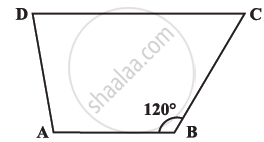
Find m∠C in the following figure if `bar(AB) || bar(DC)`
All parallelograms are trapeziums.
All squares are trapeziums.
In `square`ABCD, side BC < side AD in following figure. side BC || side AD and if side BA ≅ side CD then prove that ∠ABC ≅ ∠DCB.
PQRS is a trapezium in which PQ || SR and ∠P = 130°, ∠Q = 110°. Then ∠R is equal to ______.
A quadrilateral in which a pair of opposite sides is parallel is ______.
In trapezium ABCD with AB || CD, if ∠A = 100°, then ∠D = ______.
Every trapezium is a parallelogram.
ABCD is a trapezium such that AB || CD, ∠A : ∠D = 2 : 1, ∠B : ∠C = 7 : 5. Find the angles of the trapezium.
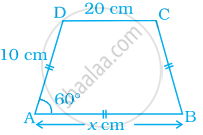
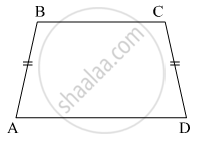
In the following figure, AB || DC and AD = BC. Find the value of x.