Advertisements
Advertisements
Question
Complete tree diagram in detail:

Advertisements
Solution

- Monera: Prokaryotic organisms are included in the kingdom of Monera. Bacteria are the most numerous members of the kingdom.
- Animalia: They are multicellular eukaryotes where cells lack chlorophyll and cell wall.
- Plantae: The Plantae kingdom is multicellular, with eukaryotic cells containing chlorophyll. Plants exhibit an alternation of generation, i.e., their life cycle has two distinct phases.
APPEARS IN
RELATED QUESTIONS
Choose the correct option:
Select odd one out for Heterotrophic bacteria.
Choose the correct option:
Paramoecium : Ciliated Protist Plasmodium : ____________
Answer the following:
What are the salient features of monera?
Answer the following:
Why is binomial nomenclature important?
Write short notes:
Useful and harmful bacteria
Write short notes:
Useful Fungi
Draw neat labelled diagrams:
Paramoecium
Draw a neat labelled diagram:
Euglena
Draw a neat labelled diagram:
TMV
Identify the following diagram, label it and write detail information in your words:

Identify the following diagram, label it and write detail information in your words:

Identify the following diagram, label it and write detail information in your words:
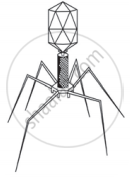
Identify the following diagram, label it and write detail information in your words:

The scientific name of the sunflower is given below. Identify the correctly written name.
Match the following:
| Kingdom | Example |
| i. Monera | a. Riccia |
| ii. Protista | b. Cyanobacteria |
| iii. Plantae | c. Rhizopus |
| iv. Fungi | d. Diatoms |
Complete the following:
Plant-like Protista - ____________
Match List I with List II -
| List-I | List-II |
| A. Rhizopus | I. Mushroom |
| В. Ustilago | II. Smut fungus |
| C. Puccinia | IIΙ. Bread mould |
| D. Agaricus | IV. Rust fungus |
Each of the following characteristics represent a Kingdom proposed by Whittaker. Arrange the following in increasing order of complexity of body organisation.
- Multicellular heterotrophs with cell wall made of chitin.
- Heterotrophs with tissue/organ/organ system level of body organisation.
- Prokaryotes with cell wall made of polysaccharides and amino acids.
- Eukaryotic autotrophs with tissue/organ level of body organisation.
- Eukaryotes with cellular body organisation.
Choose the correct answer from the options given below:
