Advertisements
Advertisements
Question
Complete the sentence below by appropriately using anyone of the following:
if you want to/if you don’t want to/if you want him to
Don’t go to the theatre__________________.
Advertisements
Solution
Don’t go to the theatre if you don’t want to.
RELATED QUESTIONS
Match the meanings with the words/expressions in italic, and write the appropriate
meaning next to the sentence.
The boy hid behind the door, not moving a muscle.
Discuss in pair and answer question below in a short paragraph (30 − 40 words.
What did George and Harris offer to pack and why?
On the basis of your understanding of the poem, answer the following question
by ticking the correct choice.
In the poem, a traveller comes to a fork in the road and needs to decide which way to go
to continue his journey. Figuratively the choice of the road denotes
______________________
Read the following sentences with the present perfect continuous tense
form.
- Mr. and Mrs. Singh have been living in the same house in the same town
for the last five years. - “Have you been keeping your pocket money safely, Rani?”
These sentences illustrate the main use of the Present Perfect Continuous tense to show that the action started in the past and is still in progress in the present.
Read the comic strip based on. H.G. Wells' novells.


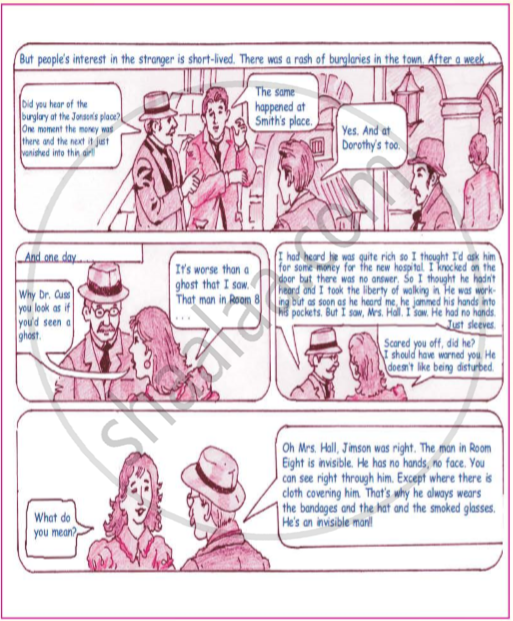
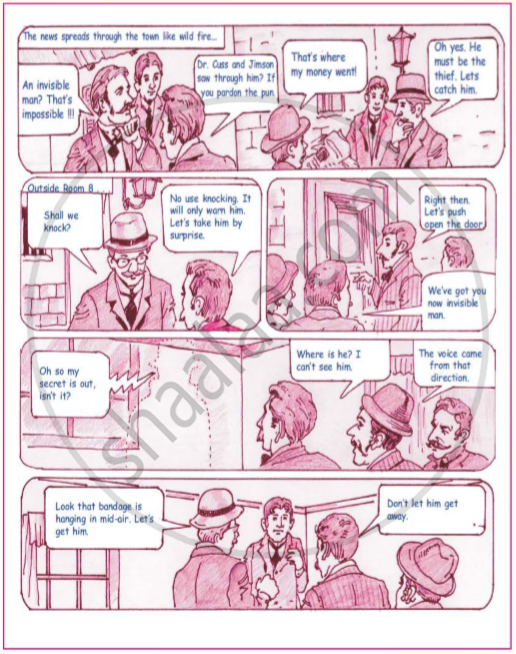
Answer the questions by ticking the correct option.
(a) The strange-looking man wanted ....
(i) the best room at the inn.
(ii} a room with a fire and a good lock.
(iii} a room with a good view.
(iv) a room where he could work quietly.
(b) Jimson was suspicious of the stranger because ...
(i} he did not answer Jimson's questions.
(ii} he did not want to talk about the weather.
(iii} he kept his back turned towards Jimson at all times.
(iv) he shouted atJimson when he entered his room.
(c) The people of the town gossiped about the stranger as ...
(i} he did not go out or talk to anyone in the town.
(ii} he had met with an accident and his face was bandaged.
(iii} he was new to the town and behaved rudely.
(iv) he stayed in his room and did not show his face to anyone.
(d) 'There was a rush of burglaries in the town. This means that ________
(i} there were many robberies in the town.
(ii) a few people in the town had seen a rob her.
(iii} the burglaries in the town were done in a rush.
(iv) the burglar was a rash and careless man.
(e) Although Jimson and Dr Cuss are suspicious of the strange guest, Mrs Hall tolerates him because ....
(i} she is not superstitious or ignorant.
(ii) she is sorry for the stranger who is bandaged.
(iii} the stranger is paying her a good amount of money for the room.
(iv} the stranger is polite and kind to Mrs Hall at all times.
(f) The stranger who was staying at the inn can be described as being ....
(I} violent
(ii} upright
(iii} dishonest
(iv) sensible
The next man looking 'cross the way
Saw one not of his church
And Couldn't bring himself to give
The fire his stick of birch.
The third one sat in tattered clothes.
He gave his coat a hitch.
Why should his log be put to use
To warm the idle rich?
The rich man just sat back and thought
of the wealth he had in store
And how to keep what he had earned
From the lazy shiftless poor.
Read the lines given above and answer the question that follow.
In stanza 3, why did the man refuse to use his stick of wood?
Some are like fields of sunlit corn,
Meet for a bride on her bridal morn,
Some, like the flame of her marriage fire,
Or, rich with the hue of her heart's desire,
Tinkling,luminous,tender, and clear,
Like her bridal laughter and bridal tear.
Read the lines given above and answer the question that follow.
Explain with reference to context.
And is mine one?' said Abou.
'Nay, or not so,'Replied the angel,
Abou spoke more low,
But cheery still; and said ,'I pray thee, then,
Write me as one that loves His fellow men.'
Read the lines given above and answer the following question.
What did Adhem ask the angel again when the angel told Adhem that he was “writing the names of those who love the Lord?”
Suddenly all the tension seemed to ebb out of my body as the truth of what he said hit me. Confidently, I drew a line a full foot in back of the board and proceeded to jump from there. I qualified with almost a foot to spare.
That night I walked over to Luz Long’s room in the Olympic village to thank him. I knew that if it hadn’t been for him I probably wouldn’t be jumping in the finals the following day. We sat in his quarters and talked for two hours—about track and field, ourselves, the world situation, a dozen other things.
When I finally got up to leave, we both knew that a real friendship had been formed. Luz would go out to the field the next day trying to beat me if he could. But I knew that he wanted me to do my best—even if that meant my winning.
Read the extract given below and answer the question that follow.
How did Owens manage to qualify for the finals with a foot to spare?
They stood in the doorway of the underground for a moment until it was raining hard. Then they closed the door and heard the gigantic sound of the rain falling in tons and avalanches, everywhere and forever.
“Will it be seven more years?” “Yes. Seven.” Then one of them gave a little cry. “Margot!” “What?” “She’s still in the closet where we locked her.” “Margot.”
They stood as if someone had driven them, like so many stakes, into the floor. They looked at each other and then looked away. They glanced out at the world that was raining now and raining and raining steadily. They could not meet each other’s glances. Their faces were solemn and pale. They looked at their hands and feet, their faces down. “Margot.” One of the girls said, “Well.. .?” No one moved. “Go on,” whispered the girl. They walked slowly down the hall in the sound of the cold rain. They turned through the doorway to the room in the sound of the storm and thunder, lightning on their faces, blue and terrible. They walked over to the closet door slowly and stood by it. Behind the closed door was only silence. They unlocked the door, even more slowly, and let Margot out.
Read the extract given below and answer the question that follow.
When would the Sun shine again? Why had the children locked Margot in the closet?
Read the extract given below and answer the questions that follow:
Lady Adela: Oh! Charlie, he did look so exactly as if he’d sold me a carpet when I was paying him.
Winsor: [changing into slippers] His father did sell carpets, wholesale, in the City.
Lady Adela: Really? And you say I haven’t intuition! [With a finger on her lips] Morison’s in there.
Winsor: [Motioning towards the door, which she shuts] Ronny Dancy took a tenner off him, anyway, before dinner.
(i) How did Dancy take a ‘tenner’ from De Levis?
How does De Levis later connect this trick with the theft?
(ii) Why, according to Lady Adela, did Dancy leave the army? Why does she call him reckless?
(iii) Where had De Levis kept the money which was stolen? Where had he gone after keeping the money? How much did he lose?
(iv) Why is Winsor outraged when De Levis says he had locked his door? What was the height of the room from the ground? How do they know that the thief did not use a ladder to climb up to De Levis’ room?
(v) How does General Canynge react when De Levis first accuses Dancy of committing the theft? What is your opinion of De Levis?
Give one reason to justify your answer.
Answer the following question.
Name two things the elephant can do with his trunk, and two he cannot.
On which planet do Tilloo and his parents live?
What happens after the poet’s father fall off the ladder?
Word in the box given below indicates a large number of… For example, ‘a herd of cows’ refers to many cows. Complete the following phrase with a suitable word from the box.
a _______________ of cattle
Multiple Choice Question:
What is the child curious about?
Look at the following phrases and their meanings. Use the phrase to fill in the blank in the sentence given below.
Why don’t you __________________ your ideas on paper?
Find out the meaning of the following words by looking them up in the dictionary. Then use them in sentences of your own.
mystic
Encircle the correct article.
Take (a/an/the) red one in (a/an/the) fruit bowl. You may take (a/an/the) orange also, if you like.
When do you have flashes of sympathy and admiration for Lady Macbeth in the course of the play? Explain by citing examples from the Acts studied. Write your answer in about 200-250 words.
