Advertisements
Advertisements
Question
Complete the following table.
| Weather | Climate |
| Short-lived condition of atmosphere | |
| Does not change quickly | |
| Expressed with respect to a specific place | |
| Elements of climate: Temperature, pressure, winds, humidity and precipitation |
Advertisements
Solution
| Weather | Climate |
| Short-lived condition of atmosphere | Long-lived condition of atmosphere. |
| Changes quickly | Does not change quickly |
| Expressed with respect to a specific place | Expressed as ‘cool and dry’ or ‘hot and humid’ or ‘hot and dry’, etc. |
| Elements of weather: Temperature, air pressure, winds, moisture and precipitation. | Elements of climate: Temperature, pressure, winds, humidity and precipitation |
APPEARS IN
RELATED QUESTIONS
Write true or false. Correct the false statement.
Heavy rainfall occurs on the leeward or rain shadow side of highland.
Write true or false. Correct the false statement.
Cyclones and anticyclones are examples of variable winds.
How is the cloud cover shown on a weather map? Give examples.
What do you understand by the term ‘4 o’clock showers’?
What are the local winds? Give a few examples.
- The diagram alongside illustrates one of the factors that affect temperature. What is it?
- Which side of the mountain is likely to have houses and be covered with trees?
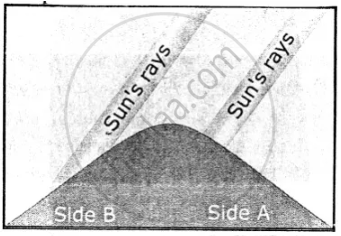
What does a large difference between the temperatures of a dry-bulb thermometer and a wet-bulb thermometer of a hygrometer indicate?
This could be a classroom activity. If your school laboratory has an anemometer, use it to record your city’s wind speed for a week. Use the Beaufort Scale to find out the character of wind during these days. Record your observations carefully in your notebook. You could even draw small neat sketches to show the effect of the wind.
Who am I?
I am present in the atmosphere in the form of vapour.
What are the elements of weather?
