Advertisements
Advertisements
Question
Complete the following sentence :
If the field lines in a magnetic field are parallel and equidistant, the magnetic field is __________ .
Advertisements
Solution
If the field lines in a magnetic field are parallel and equidistant, the magnetic field is Uniform.
APPEARS IN
RELATED QUESTIONS
What are the two ways in which you can trace the magnetic field pattern of a bar magnet?
A thick wire is hanging form a wooden table. An anticlockwise magnetic field is to be produced around the wire by passing current through this wire by using a battery. Which terminal of the battery should be connected to the:
(a) top end of wire?
(b) bottom end of wire?
Give reason for your choice.
A charged particle enters at right angles into a uniform magnetic field as shown:
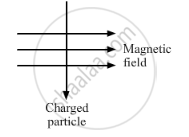
What should be the nature of charge on the particle if it begins to move in a direction pointing vertically our of the page due to its interaction with the magnetic field?
Select the correct option:
Nickel is a:
Define the Isogonic line.
Complete the following diagram of magnets to show the lines of force.
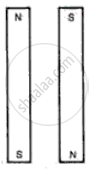
Inside the magnet, the field lines moves ____________.
A circular loop placed in a plane perpendicular to the plane of paper carries a current when the key is ON. The current as seen from points A and B (in the plane of paper and on the axis of the coil) is anti clockwise and clockwise respectively. The magnetic field lines point from B to A. The N-pole of the resultant magnet is on the face close to

A student fixes a white sheet of paper on a drawing board. He places a bar magnet in the centre and sprinkles some iron filings uniformly around the bar magnet. Then he taps gently and observes that iron filings arrange themselves in a certain pattern.
- Why do iron filings arrange themselves in a particular pattern?
- Which physical quantity is indicated by the pattern of field lines around the bar magnet?
- State any two properties of magnetic field lines.
Name the poles P, Q, Rand S of the magnets in the following figures 'a' and 'b':
 |
 |
| Figure 'a' | Figure 'b' |
