Advertisements
Advertisements
Questions
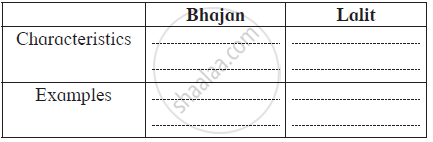
Complete the following chart.
| Bhajan | Keertan | Lalit | Bharud | |
| Characteristics | ||||
| Examples |
Complete the following chart.
| Bhajan | Bharud | |
| Characteristics | ____________ | ____________ |
| Examples | ____________ | ____________ |
Advertisements
Solution
| Bhajan | Keertan | Lalit | Bharud | |
| Characteristics |
It is a devotional song that glorifies God. It used a wide variety of instruments, such as Taal, mridangam, etc. Bhajans are classified into two types: Chakri Bhajan, where devotees move in circular motion and sing without a break. Songi Bhajan, where dialogues are delivered in the form of devotional songs. Tukadoji Maharaj propounded Khanjiri Bhajan. |
Saint Namadev was the proponent of varakari sect and the first Keertankar of Maharashtra. Also called Haridas or Kathekaribuva, Keertankar dresses traditionally and learns singing, oratory, dance and humour. |
It is a form of entertainment that traces its history from Naradiya Keertan. It is famous in Maharashtra, Goa and Konkan |
It is a song that is spiritual and ethical in nature. It aims to educate people on various aspects of life. They are similar to roadshows. |
| Examples | Bhajans were composed by saints Tulsidas and Kabir. | Keertans were performed in temples. | Theatrical-style performance is based on the stories of Rama and Krishna. | Bharuds composed by saint Eknath are famous in Maharashtra. |
Notes
Students should refer to the answer according to their question and preferred marks.
APPEARS IN
RELATED QUESTIONS
Complete given concept maps
Complete the concept map :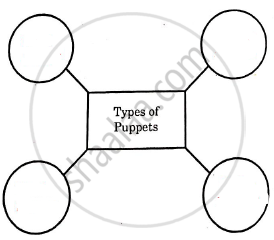
Explain the following statement with reasons:
Bharuds composed by Saint Eknath the are popular in Maharashtra.
______ is supposed to be the first keertankar in Maharashtra.
Answer the question in 25-30 words.
What is Powada?
Read the following extract and answer the questions below :
|
Dashavatara Theatre: Dashavatara is part of the folk theatre in Maharashtra. Dashavatara shows are presented in the regions of Konkan and Goa after harvesting season is over. The stories presented in these shows are based on the 10 incarnations of Vishnu, namely Matsya, Koorma, Varaha, Narsimha, Wamana, Parashurama, Ram, Krishna, Buddha and Kalki. At the beginning of the show Sutradhara, the narrator invokes Lord Ganesha, the destroyer of obstacles. The method of acting, make-up, costumes in Dashavatara shows is set by the tradition. The show is mostly musical but sometimes there may be a few spontaneous dialogues. The characters representing gods use wooden masks. The show ends by breaking dahihandi, an earthen pot of curds, followed by aarati, singing praises of the God. In the 18th century Shyamji Naik Kale started a phad, of Dashavatara artists which used to perform all over Maharashtra. Vishnudas Bhave, the pioneer of Marathi theatre staged mythological plays by introducing some modifications in the Dashavatara style. Thus, the origins of the Marathi theatre can be traced to Dashavatara tradition. |
- In which state Dashavatara is part of folk theatre?
- To whom the narrator invokes at the beginning of the show?
- The form of Dashavatara folk theatre. Explain.
Identify and write the wrong pair in the following set:
Observe the picture given below and answer the questions that follow.

- What is the given art traditionally called in India?
- Name any two archaeological sites where excavations of clay dolls were found.
- Name any two Indian states where artists performing puppet shows are found.
- What is the role of the narrator known in the puppet show?
Describe in brief the Dashavatara shows.
Complete the following table:
| Lalit | Bharud | |
| Characteristics | ||
| Example |
