English
Maharashtra State BoardSSC (English Medium) 10th Standard

Complete the flowchart. - Science and Technology 2

Advertisements
Advertisements

Question

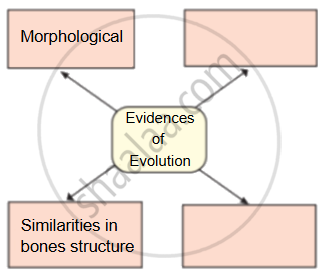
Complete the flowchart.

Chart
Advertisements

Solution

shaalaa.com
  Is there an error in this question or solution?
Chapter 1: Heredity and Evolution - Solve the following questions

APPEARS IN

SCERT Maharashtra Science and Technology 2 [English] 10 Standard SSC
Chapter 1 Heredity and Evolution
Solve the following questions | Q 2

RELATED QUESTIONS

What are vestigial organs?


Differentiate between homology and analogy. Give one example of each.


“Two areas of study namely 'evolution' and 'classification' are interlinked'. Justify this statement.


Four students P, Q, R and S differently reported the following set of organs to be analogous :

P. Forelimb of a frog and forelimb of a lizard

Q. Forelimb of a bird and forelimb of a human

R. Wings of a parrot and wings of a butterfly

S. Wings of a bird and wings of a bat

The two students who have reported correctly are :

(A) P and Q

(B) Q and R

(C) R and S

(D) P and S


Give the importance of fossil in support of organic evolution


How do homologous organs help in providing evidence for organic evolution?


Human tailbone is a vestigial organ. Explain.


Differentiate between analogous and homologous structures.


The organs which perform similar functions but have different basic structure are called :
(a) asymmetric organs
(b) analogous organs
(c) homologous organs
(d) homophonic organs


 The wings of a housefly and the wings of a sparrow are an example of :
(a) analogous organs
(b) vestigial organs
(c) respiratory organs
(d) homologous organs


There are five animals A, B, C, D and E. The animal A uses its modified forelimbs for flying. The animal B uses its forelimbs for running whereas the animal C uses its forelimbs for grasping. The animal D can live on land as well as in water and uses its forelimbs to prop up the front end of its body when at rest. The animal E which respires by using spiracles and tracheae uses wings for flying but its wings are analogous to the modified forelimbs of animal A.
(a) What could the animals A, B, C, D and E be?
(b) Why are the forelimbs of animals A, B, C, D called homologous organs?
(c) What does the existence of homologous organs in animals A, B, C and D tell us about their ancestors ?
(d) Why are the modified forelimbs of animal A and the wings of animal E called analogous organs?
(e) State whether animals A and E have a common ancestor or not.


X, Y, and Z are three animals. The animal X can fly but animal Y can only run on ground or walls. The forelimbs of animals X and Y have the same basic design but they are used for different purposes such as flying and running respectively. The animal Z became extinct an long time ago. The study of fossils of Z tells us that it had some features like those of X and some like those of Y. In fact, Z is said to form a connecting link in the evolutionary chain of X and Y.
(a) What could the animals X, Y and Z be?
(b) What name is given to the forelimbs like those of X and Y which have the same basic design but different functions?
(c) Name one feature in which Z resembled X.
(d) Name one feature in which Z resembled Y.
(e) Which is the correct evolutionary chain involving X, Y and Z : X → Z → Y or Y → Z → X?


Select a set of homologous organs from the following: 
(A) Wings of a bat and wings of a butterfly
(B) Wings of a pigeon and wings of a bat
(C) Wings of a butterfly and wings of a pigeon
(D) Forelimbs of a duck, forelimbs of a cow and forelimbs of a lizard


In a class, students were asked to observe the models/slides/pictures of the skeletons of forelimbs and wings of different organisms. After the observations the students made the following groups of homologous structures. Select the correct group :
(A) Wings of a bird and a butterfly
(B) Wings of a pigeon and a bat
(C) Wings of a butterfly and a bat
(D) Forelimbs of a cow, a duck and a lizard


Answer the following question.
Wisdom teeth : Vestigial organs :: Lungfish : ....................


Choose the correct option of the following question:

Wings of Insect and Birds are examples of :


Define fossil.


Find an odd one out.


Find an odd one out.


What is carbon dating?


Observe the given images and answer the following questions.

  1. Which evolutionary evidence does it indicate?
  2. What does it prove?
  3. State another example of evolutionary evidence.

Which of these is not a vestigial organ in human beings?


Define vestigial organs.


Why do all the gametes formed in human females have an X chromosome?


Cucurbits do not develop thick and woody stem as they are:


Palaeontological evidence for evolution refers to the ______.


The bones of forelimbs of whale, bat, cheetah and man are similar in structure, because ______.


Analogous organs arise due to ______.


How do we compute the age of a living tree?


The evolutionary story of moths in England during industrialisation reveals, that 'evolution is apparently reversible'. Clarify this statement.


Complete the following diagram:


Complete the following chart:


What is the function of the appendix of our digestive system?


Find odd one out:


Write avian characters of Archaeopteryx.


Give one example of homologous organs found in plants.


Pick the odd man out:


Share
Notifications

Englishहिंदीमराठी


      Forgot password?
Use app×