Advertisements
Advertisements
Question
Comment on the statement: ‘When any ray of white light is incident on a glass prism, it simply disperses it into its seven constituent colours.
Advertisements
Solution
Before making any comment, the following simple experiment should be performed.
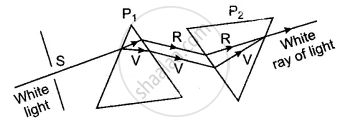
Arrangement is shown in the diagram. P1 and P2 are two glass prisms exactly similar and placed at some distance from each of the such that their refracting surfaces are parallel to each other and the base of the prism P2 is upwards and vertex downwards. S is a narrow slit through which a ray of white light is incident on the refracting face of the prism P1. It is dispersed by it into its seven constituent colours.
When this dispersed light falls on the refracting surface of the prism P2, having its base upwards so that the rays have deviated in a direction different from the first, we see on the screen only a white spot of light. It is evident that the second prism P2 recombines these colours to form white light acting as a ‘recombination prism’ while the first prism acts as a ‘dispersing prism’.
RELATED QUESTIONS
Name three factors on which the deviation produced by a prism depends and state how does it depend on the factors stated by you.
In following figure shows a thin beam of white light from a source S striking on one face of a prism.
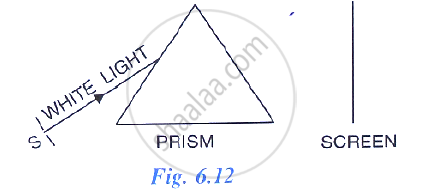
Complete the diagram to show effect of prism on the beam and to show what is seen on the screen.
In following diagram shows a thin beam of white light from a source S striking on one face of a prism.
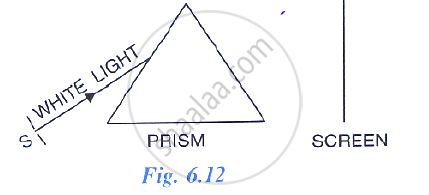
What conclusion do you draw from the observation in part (b) above?
If a monochromatic beam of light undergoes minimum deviation through an equiangular prism, how does the beam pass through the prism, with respect to its base?
Light of different colours is deviated through different angles by a prism. Explain the reason.
Name the radiation of a wavelength longer than 8 × 10⁻⁷ m.
Which colour of white light travels slowest, in glass?
Write the approximate wavelength for red light.
The wavelengths for the light of red and blue colours are nearly 7·8 × 10-7 m and 4·8 × 10-7 m respectively.
Which colour has greater speed in glass?
