Advertisements
Advertisements
Question
Change is the law of nature and occurs in our everyday life, at all times and in all places.
Differentiate between the following change with a suitable example.
Periodic and non-periodic change
Advertisements
Solution
| Periodic change | Non-periodic change |
| (i) Changes which occur periodically (occur again and again) at regular intervals of time. | (i) Changes which do not occur periodically (do not repeat) at regular intervals of time. |
| (ii) Examples of a periodic change: Change of seasons, the occurrence of day and night, movement of a clock pendulum. |
(ii) Examples of a non-periodic change: Change of weather, growth of a plant, cyclones, earth-quakes, rusting of iron, thunder, and lightning. |
APPEARS IN
RELATED QUESTIONS
Tick the most appropriate answer
2. Melting of ice is a
- reversible change
- irreversible change
- chemical change
- none of these
Fill in the blank.
A new substance is formed in a ............... change.
State whether the following is physical or chemical changes.
photosynthesis —
Tick (√) the correct alternative from the choice given for the following statement.
The compound rust is a hydrated oxide of
Solve this crossword by using the clues that follow-
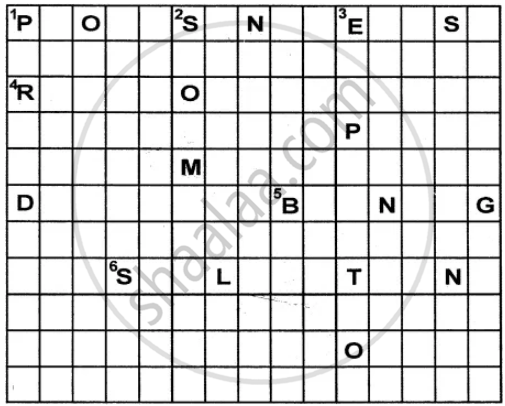
Across
1. Energy in the form of sunlight is absorbed by the green plants in this process.
4. The reddish-brown substance formed over iron in the presence of oxygen and moisture.
5. This change is permanent and irreversible.
6. The process in which a solid directly changes into gaseous state.
Down
1 . It is the change that takes place in case of swinging pendulum of a clock. –
2. Occurrence of this is a non-periodic change as well as a natural change.
3. It is a physical change.
Which of the following are physical changes and which are chemical changes ?
Glowing of an electric bulb
Classify the following as a physical or a chemical change.
Drying of wet clothes
What will you take into account while identifying the following?
A physical change in a substance.
State what is meant by the term – interconversion of matter. Is interconversion of matter a physical change or a chemical change.
Give a reason why
Change of seasons is a periodic change while the change of weather is a non-periodic change.
