Advertisements
Advertisements
Question
Advertisements
Solution
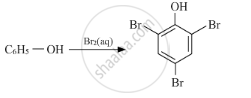
APPEARS IN
RELATED QUESTIONS
Propanal and Propanone
Give a simple chemical test to distinguish between the following pair of compounds:
Acetophenone and Benzophenone
Oxidation of ketones involves carbon-carbon bond cleavage. Name the products formed on oxidation of 2, 5-dimethylhexan-3-one.
Which of the following compounds gives a positive Tollen's test but negative Fehling's test?
Which sugar does not reduce Fehling's solution?
Fehilng's test is positive for
What is the composition of Fehling's reagent?
The correct set of products obtained in the following reactions:
- \[\ce{RCN ->[reduction]}\]
- \[\ce{RCN ->[(i) CH3MgBr][(ii) H2O]}\]
- \[\ce{RNC ->[hydrolysis]}\]
- \[\ce{RNH2 ->[HNO2]}\]
You are given four organic compounds “A”, “B” , “C” and “D”. The compounds “A”, “B” and “C” form an orange-red precipitate with 2, 4 DNP reagent. Compounds “A” and “B” reduce Tollen’s reagent while compounds “C” and “D” do not. Both “B” and “C” give a yellow precipitate when heated with iodine in the presence of NaOH. Compound “D” gives brisk effervescence with sodium bicarbonate solution. Identify “A”, “B”, “C” and “D” given the number of carbon atoms in three of these carbon compounds is three while one has two carbon atoms. Give an explanation for our answer.
Fehling’s solution ‘A’ is ______.
