Advertisements
Advertisements
Question
Bring out a contrast between Mr. Purcell and the customer.
Advertisements
Solution
Purcell did not give much importance to freedom. He sold pets in cages and earned money. He took pleasure in engaging birds and animals. He was crazy about gaining money. But the customer was built of different stuff. His prison life had made him realise the value and meaning of freedom. He bought a pair of doves with the money he had earned in the jail. He drew out the doves from the cages and tossed them into the air. He took pleasure in freeing the encaged birds. Thus, we can say that both Mr. Purcell and the customer were shortly different from each other.
RELATED QUESTIONS
Mahendra calls ghosts or spirits a figment of the imagination. What happens to him on a full-moon night?
Working in small groups of 4−5 students, go back over the two passages on Santosh Yadav and Maria Sharapova and complete the table given below with relevant phrases or sentences.
|
Points of Comparison/Contrast |
Santosh Yadav | Maria Sharapova |
|
1. Their humble beginning |
|
|
|
2 . Their parents’ approach |
|
|
|
3. Their will power and strong desire to succeed |
|
|
|
4. Evidence of their mental toughness |
|
|
|
5. Their patriotism |
|
Think of an occasion when you participated in a team competition. Think back on the leadership qualities displayed by your Team Leader/Captain. Recollect the specific incidents when those were displayed and how they contributed to the success of the team.
Write an e-mail to your mentor-teacher sharing this experience.
On the basis of your understanding of the poem, answer the following question
by ticking the correct choice.
'The Solitary Reaper' is a narrative poem set to music. This form of verse is called
a______.
Look at the passage below and study how the personal pronouns refer to different people.
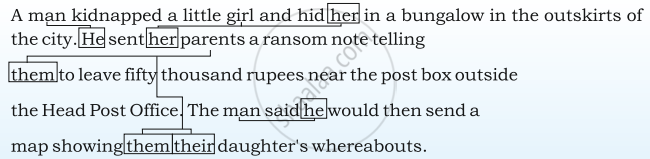
The angel wrote and vanished.
The next night, It came again with a great wakening light,
And show's the names whom love of God had blest,
And Lo! Bin Adhem's name led all the rest.
Read the lines given above and answer the following question.
Where was Abou’s name written amongst those who loved God?
The horse was nearly life-size, moulded out of clay, baked, burnt, and brightly coloured, and reared its head proudly, prancing its forelegs in the air and flourishing its tail in a loop; beside the horse stood a warrior with scythelike mustachios, bulging eyes, and aquiline nose. The old image-makers believed in indicating a man of strength by bulging out his eyes and sharpening his moustache tips, and also decorated the man’s chest with beads which looked today like blobs of mud through the ravages of sun and wind and rain (when it came), but Muni would insist that he had known the beads to sparkle like the nine gems at one time in his life.
Read the extract given below and answer the question that follow.
Why had the image makers given the warrior bulging eyes and aquiline nose?
“You haven’t brought home that sick brat!” Anger and astonishment were in the tones of Mrs. Joe Thompson; her face was in a flame.
“I think women’s hearts are sometimes very hard,” said Joe. Usually Joe Thompson got out of his wife’s way, or kept rigidly silent and non-combative when she fired up on any subject; it was with some surprise, therefore, that she now encountered a firmly-set countenance and a resolute pair of eyes.
“Women’s hearts are not half so hard as men’s!”
Joe saw, by a quick intuition, that his resolute bearing h«d impressed his wife and he answered quickly, and with real indignation, “Be that as it may, every woman at the funeral turned her eyes steadily from the sick child’s face, and when the cart went off with her dead mother, hurried away, and left her alone in that old hut, with the sun not an hour in the sky.”
“Where were John and Kate?” asked Mrs. Thompson.
“Farmer Jones tossed John into his wagon, and drove off. Katie went home with Mrs. Ellis; but nobody wanted the poor sick one. ‘Send her to the poorhouse,’ was the cry.”
“Why didn’t you let her go, then. What did you bring her here for?”
“She can’t walk to the poorhouse,” said Joe; “somebody’s arms must carry her, and mine are strong enough for that task.”
Read the extract given below and answer the question that follow.
What does Mr Thompson feel about the other women who had left Maggie alone and gone away?
Read the extract given below and answer the questions that follow :
Giles: I beg your pardon. Did you say something?
Trotter: Yes, Mr. Ralston, I said ‘Is there an extension ?’ (He crosses to Centre.)
Giles: Yes, up in our bedroom.
Trotter: Go and try it up there for me, will you?
(Giles exits to the stairs, carrying the glove and bus ticket and looking dazed. Trotter continues to trace the wire to the window. He pulls back the curtain and opens the window, trying to follow the wire. He crosses to the arch up Right, goes out and returns with a torch. He moves to the window, jumps out and bends down, looking, then disappears out of sight. It is practically dark. Mrs. Boyle enters from the library up Left, shivers and notices the open window.)
Mrs Boyle: (Moving to the window) Who has left this window open?
(i) Why did Giles fail to hear what Trotter had said earlier·? Why did Giles look 'dazed'?
(ii) What was Trotter attempting to do? Why?
(iii) Why did Mrs. Boyle close the window? What did tl1e voice on the radio say about the 'mechanics of fear'?
(iv) How did the murderer mask the sounds of the killing? Who entered the room immediately after the murder? What did this person see?
(v) Who was the victim? Why was the victim murdered? What was the 'signature tune' that the murderer whistled? What is the significance of this tune in the context of the play?
In a desert the temperature rises during the day and falls rapidly at night. Why?
What did Tilloo hope to see once he emerged from his underground home?
Do we usually say that an animal ‘wears’ a tail? What do we say? (Think: Does an animal wear a coat? Consulta dictionary if you like, and find out how ‘wear’ is used in different ways
Complete the sentence below by appropriately using anyone of the following:
if you want to/if you don’t want to/if you want him to
Don’t eat it____________________.
Why/when did Abbu Khan become unhappy?
It is said that Tansen was a naughty child. What prank did he play?
Discuss the question in pairs before you write the answer.
Who did he choose next?
Match the following.
|
1. |
unprecedented space tragedy |
|
|
2. |
certified flight instructor |
|
|
3. |
space mission |
|
|
4. |
super specialisation |
|
|
5. |
encyclopaedic knowledge |
|
|
6. |
awe-inspiring |
|
|
7. |
in this age |
|
How did Rasheed lose all his money at the Lucky shop?
"The quality of mercy is not stained." Who say this to whom?
Which of the following statements is NOT true of Maggie?
