Advertisements
Advertisements
Question
Boyle’s law is applicable for an ______.
Options
adiabatic process.
isothermal process.
isobaric process.
isochoric process.
Advertisements
Solution
Boyle’s law is applicable for an isothermal process.
Explanation:
Boyle’s law: For a given mass of an ideal gas at a constant temperature, the volume of a gas is inversely proportional to its pressure.
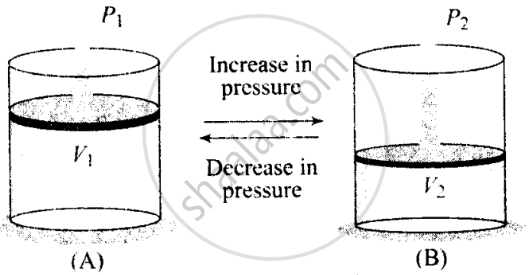
So we can say that when the temperature is constant, Boyle’s law is applicable.
i.e., PV = nRT = constant
⇒ PV = constant ....(At constant temperature)
i.e., p ∝ 1/V— .....[where, P = pressure. V= volume]
So, this law is applicable to an isothermal process, in which temperature remains constant.
APPEARS IN
RELATED QUESTIONS
Let Ta and Tb be the final temperatures of the samples A and B, respectively, in the previous question.
The perfect gas equation for 4 g of hydrogen gas is ______.
When a Van der Waal's gas undergoes free expansion, then its temperature ______.
Match Column - I and Column - II and choose the correct match from the given choices.
| Column - I | Column - II | ||
| (A) | Root mean square speed of gas molecules | (P) | `1/3"nm"overline"v"^2` |
| (B) | The pressure exerted by the ideal gas | (Q) | `sqrt((3"RT")/"M")` |
| (C) | The average kinetic energy of a molecule | (R) | `5/2"RT"` |
| (D) | The total internal energy of 1 mole of a diatomic gas | (S) | `3/2"k"_"B""T"` |
Match Column - I and Column - II and choose the correct match from the given choices.
| Column - I | Column - II | ||
| (A) | Root mean square speed of gas molecules | (P) | `1/3"nm"υ^(-2)` |
| (B) | Pressure exerted by ideal gas | (Q) | `sqrt((3"RT")/"M")` |
| (C) | Average kinetic energy of a molecule | (R) | `5/2"RT"` |
| (D) | Total internal energy of 1 mole of a diatomic gas | (S) | `3/2"k"_"B""T"` |
1 mole of H2 gas is contained in a box of volume V = 1.00 m3 at T = 300K. The gas is heated to a temperature of T = 3000K and the gas gets converted to a gas of hydrogen atoms. The final pressure would be (considering all gases to be ideal) ______.
The volume of a given mass of a gas at 27°C, 1 atm is 100 cc. What will be its volume at 327°C?
When air is pumped into a cycle tyre the volume and pressure of the air in the tyre both are increased. What about Boyle’s law in this case?
Starting with the same initial conditions, an ideal gas expands from volume V1 to V2 in three different ways. The work done by the gas is W1 if the process is purely isothermal, W2, if the process is purely adiabatic and W3 if the process is purely isobaric. Then, choose the correct option.
A vessel contains 16 g of hydrogen and 128 g of oxygen at standard temperature and pressure. The volume of the vessel in cm3 is ______.
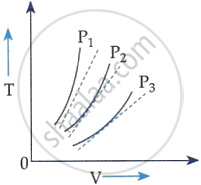
The following graph represents the T-V curves of an ideal gas (where T is the temperature and V the volume) at three pressures P1, P2 and P3 compared with those of Charles’s law represented as dotted lines.
A container has two chambers of volumes V1 = 2 L and V2 = 3 L separated by a partition made of a thermal insulator. The chambers contain n1 = 5 and n2 = 4 moles of ideal gas at pressures p1 = 1 atm and p2 = 2 atm, respectively. When the partition is removed, the mixture attains an equilibrium pressure of:
