Advertisements
Advertisements
Question
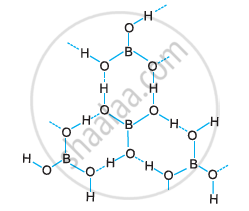
Boric acid is polymeric due to ______.
Options
its acidic nature
the presence of hydrogen bonds
its monobasic nature
its geometry
Advertisements
Solution
Boric acid is polymeric due to the presence of hydrogen bonds.
Explanation:
Boric acid is polymeric because of the presence of hydrogen bonds. In the given figure, the dotted lines represent hydrogen bonds.
RELATED QUESTIONS
A certain salt X, gives the following results.
- Its aqueous solution is alkaline to litmus.
- It swells up to a glassy material Y on strong heating.
- When conc. H2SO4 is added to a hot solution of X, white crystal of an acid Z separates out.
Write equations for all the above reactions and identify X, Y and Z.
Write a balanced equation for B2H6 + H2O → ?
Write a balanced equation for NaH + B2H6 → ?
Write a balanced equation for \[\ce{H3BO3 ->[\Delta]}\]?
An aqueous solution of borax is _______.
Boric acid is an acid because its molecule ______.
Draw the structure of boric acid showing hydrogen bonding. Which species is present in water? What is the hybridisation of boron in this species?
When aqueous solution of borax is acidified with hydrochloric acid, a white crystalline solid is formed which is soapy to touch. Is this solid acidic or basic in nature? Explain.
What are boranes? Give chemical equation for the preparation of diborane.
A compound (A) of boron reacts with NMe3 to give an adduct (B) which on hydrolysis gives a compound (C) and hydrogen gas. Compound (C) is an acid. Identify the compounds A, B and C. Give the reactions involved.
Which of the following is a FALSE statement about boric acid, \[\ce{H3BO3}\]?
Which is correct statement about diborane structure?
Aqueous solution of which of the following boron compounds will be strongly basic in nature?
Diborane (B2H6) reacts independently with O2 and H2O to produce, respectively:
Which of the following compounds are formed when boron trichloride is treated with water?
Boric acid (H3BO3) is ______.
