Advertisements
Advertisements
Question
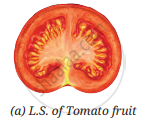
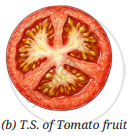
Assist your elders in cutting fruits in the kitchen. While cutting fruits like lady finger, tomato, brinjal, capsicum, papaya, orange, muskmelon and more, make your observations based on the following and draw diagrams -
- When you cut a fruit longitudinally (Longitudinal Section: L.S.)
- When you cut a fruit transversely (Transverse Section: T.S.)
- Attachment of seeds
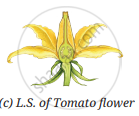
Link your observations of the L.S. and T.S. of the fruit with the internal structure of the ovary of same species.
Advertisements
Solution
- Longitudinal Section (L.S.): Cutting the fruit vertically from base to apex reveals the vertical length of the internal chambers, the central core, and how seeds are aligned along the vertical axis.
- Transverse Section (T.S.): Cutting the fruit horizontally across its width reveals the circular fruit wall (pericarp), radial partitions, and the cross-sectional arrangement of internal locules.
- Attachment of seeds: Examining how seeds are anchored inside the fruit helps identify the type of placentation (such as axile placentation in tomatoes/oranges or parietal placentation in papaya/muskmelon).
Link your observations of the L.S. and T.S. of the fruit with the internal structure of the ovary of the same species. The fruit wall (pericarp) develops directly from the ovary wall after fertilization. Furthermore, the internal chambers (locules) and partitions seen in the sections of the fruit correspond directly to the locules and carpel walls of the multi-chambered ovary found in the flower. Finally, the seeds and their specific arrangement inside the mature fruit originate from the fertilized ovules and match the exact placentation type present in the ovary of that flower species.
