Advertisements
Advertisements
Question
Answer the following question briefly:
With reference to the Treaty of Allahabad and its impact, answer the following:
Explain how the treaty between Robert Clive and the Mughal emperor Shah Alam II legalized English East India’s Company’s control over Bengal.
Advertisements
Solution
The British gave Shah Alam II the districts of Kora and Allahabad and an annual pension of 26 lakh rupees. In return, the emperor (the nominal head of the Mughal empire) granted the Company the Diwani of Bengal, Bihar, and Orissa, e., the right to collect revenue from these provinces and judge civil cases. The Company’s control over Bengal was made legal.
APPEARS IN
RELATED QUESTIONS
Match the Column:
| Column A | Column B |
| 1. Carnatic Wars | (a) Warren Hastings |
| 2. Farman | (b) duty-free trade |
| 3. Roberts Clive | (c) reconquered Calcutta |
| 4. Battle of Plassey | (d) Siraj-ud-Daulah |
| 5. Battle of Buxar | (e) Anglo-French rivalry |
| 6. Governor of Bengal | (f) Mir Qasim |
Answer the following question briefly:
The Battle of Plassey was a major turning point in the history of India. In this context answer the following question:
Give an account of the events leading from the conspiracy to replace Siraj-ud-Daulah to his eventual defeat in the Battle of Plassey.
Answer the following question briefly:
The Battle of Plassey was a major turning point in the history of India. In this context answer the following question:
State the results of the Battle of Plassey.
Answer the following question briefly:
Mir Qasim was a competent ruler, determined to free himself from foreign control. In this context answer the following:
Trace the events from the outbreak of war (1763) between Mir Qasim and the British up to the Battle of Buxar in 1764.
Answer the following question briefly:
Mir Qasim was a competent ruler, determined to free himself from foreign control. In this context answer the following:
Explain the importance of the Battle of Buxar.
This picture portrays a momentous event in 1765, involving a British Governor and a Mughal emperor wherein the Mughal emperor is conveying the grant of the Diwani to the governor.
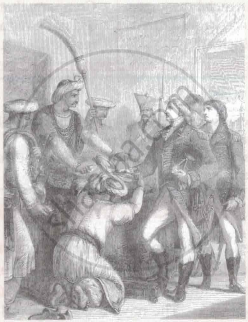
Give a brief account of the battle that preceded this event. When did it take place?
Match the Contents of Column A Column B.
| Column A | Column B |
| 1. Shuja-ud-daulah | (a) Nawab of Bengal |
| 2. Shah Alam II | (b) Founder of British Empire in India |
| 3. Mir Qasim | (c) 1765 |
| 4. Siraj-ud-daulah | (d) 1765–1772 |
| 5. Battle of Plassey | (e) Calcutta |
| 6. Battle of Buxar | (f) Formed an alliance with the Mughal Emperor and Nawab of Awadh. |
| 7. Grant of Diwani | (g) Mughal Emperor |
| 8. Dual Government | (h) Nawab of Awadh |
| 9. Clive | (i) 1757 |
| 10. Forth William | (j) 1764 |
Answer the following question:
How did Mir Qasim become the Nawab of Bengal?
Fill in the blanks:
The British had to face the challenge of the rulers of ________ and __________, ___________after the conquest of Bengal.
Answer the following question:
What were the causes and results of the First Anglo-Maratha War? When was it fought?
