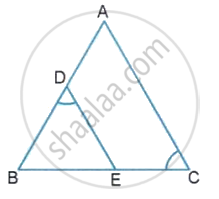
Assertion (A): In the figure, if \(\angle \mathrm{EDB} = \angle \mathrm{ACB}, \mathrm{BE} = 6 \mathrm{~cm}), (\mathrm{EC} = 4 \mathrm{~cm}) and (\mathrm{BD} = 5 \mathrm{~cm})
Advertisements
Question
Assertion (A): In the figure, if \(\angle \mathrm{EDB} = \angle \mathrm{ACB}, \mathrm{BE} = 6 \mathrm{~cm}\), \(\mathrm{EC} = 4 \mathrm{~cm}\) and \(\mathrm{BD} = 5 \mathrm{~cm}\), then the length of AB is 12 cm.
Reason (R): If two triangles have two pairs of corresponding angles equal, then the triangles are similar.
Options
Both A and R are true, and R is the correct explanation of A.
Both A and R are true, but R is not the correct explanation of A.
A is true, but R is false.
A is false, but R is true.
Advertisements
Solution
Both A and R are true, and R is the correct explanation of A.
Explanation:
In ΔABC and ΔEBD, ∠ABC = ∠EBD and ∠ACB = ∠EDB, so ΔABC ∼ ΔEBD by AA. Hence $$\frac{AB}{BE} = \frac{BC}{BD} = \frac{10}{5} = 2$$, so $$AB = 12$$ cm. R correctly explains the similarity criterion used.
