Assertion (A): In the figure, D is the mid-point of BC and AD ⊥ BC. If E lies on AD, then BE = CE. Reason (R): Every point on the perpendicular bisector of a line segment is equidistant
Advertisements
Question
Assertion (A): In the figure, D is the mid-point of BC and AD ⊥ BC. If E lies on AD, then BE = CE.
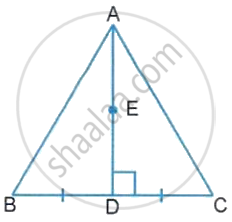
Reason (R): Every point on the perpendicular bisector of a line segment is equidistant from its end points.
Options
Both A and R are true, and R is the correct explanation of A.
Both A and R are true, but R is not the correct explanation of A.
A is true, but R is false.
A is false, but R is true.
MCQ
Assertion and Reasoning
Advertisements
Solution
Both A and R are true, and R is the correct explanation of A.
Explanation:
Since D is the midpoint of BC and AD ⊥ BC, AD is the perpendicular bisector of BC. Any point E on AD lies on this perpendicular bisector, so it is equidistant from B and C; hence BE = CE. Thus R correctly explains A.
shaalaa.com
Is there an error in this question or solution?
