Advertisements
Advertisements
Question
Arrange the rational numbers `(-7)/10, 5/(-8), 2/(-3), (-1)/4, (-3)/5` in ascending order.
Advertisements
Solution
Given rational numbers are `(-7)/10, 5/(-8), 2/(-3), (-1)/4, (-3)/5`
To arrange in any order, we make denominators of all rational numbers as same.
∴ LCM of 10, 8, 3, 4 and 5 is 120
So, `(-7 xx 12)/(10 xx 12), (5 xx 15)/(-8 xx 15), (2 xx 40)/(-3 xx 40), (-1 xx 30)/(4 xx 30), (-3 xx 24)/(5 xx 24)`
= `(-84)/120, 75/(-120), 80/(-120), (-30)/120, (-72)/120`
= `(-84)/120, (-75)/120, (-80)/120, (-30)/120, (-72)/120`
Since, denominators are same, so ascending order of numerators are –84, –80, –75, –72, –30
Hence, `(-84)/120 < (-80)/120 < (-75)/120 < (-72)/120 < (-30)/120`
i.e. `(-7)/10 < 2/(-3) < 5/(-8) < (-3)/5 < (-1)/4`
APPEARS IN
RELATED QUESTIONS
The product of two rational numbers is always a ________.
Draw the number line and represent the following rational numbers on it:
`(-7)/4`
Which of the following pairs represent the same rational number?
`(-3)/5 "and" (-12)/20`
Which of the following pairs represent the same rational number?
`1/3 "and" (-1)/9`
Rewrite the following rational number in the simplest form:
`25/45`
Which is greater in the following?
`(-1)/4, 1/4`
`(-5)/4` is a rational number which lies between __________
A mother and her two daughters got a room constructed for Rs. 62,000. The elder daughter contributes `3/8` of her mother’s contribution while the younger daughter contributes `1/2` of her mother’s share. How much do the three contribute individually?
The table given below shows the distances, in kilometres, between four villages of a state. To find the distance between two villages, locate the square where the row for one village and the column for the other village intersect.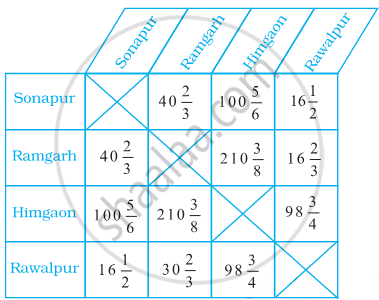
If you drove from Himgaon to Sonapur and then from Sonapur to Rawalpur, how far would you drive?
