Advertisements
Advertisements
Question
Anu was assigned a project work by her physical education teacher. She had to make a report by checking the health status of all the security guards of her huge gated community. She found out that more than half of them showed a significant deformity in the upper part of their vertebral column.
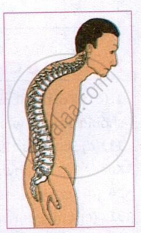
1. The term used to define this deformity is ______.
(a) Lordosis
(b) Scoliosis
(c) Kyphosis
(d) Both Lordosis & Scoliosis
2. This deformity is mainly caused due to:
(a) Carrying heavy loads
(b) Lack of exercise
(c) Weak muscles
(d) All of the above
3. Which of the following helps in rectifying such condition?
(a) Chakrasana
(b) Dhanurasana
(c) Halasana
(d) Both Chakrasana & Dhanurasana
4. Bending head backward in standing position helps in getting rid of:
(a) Lordosis
(b) Kyphosis
(c) Scoliosis
(d) Both Lordosis & Kyphosis
5. Due to Covid Pandemic, most of the children attending online classes with bad sitting posture may experience this condition later:
(a) Kyphosis
(b) Lordosis
(c) Scoliosis
(d) Flat foot
Advertisements
Solution
- The term used to define this deformity is kyphosis.
Explanation:
Kyphosis is an exaggerated rounding of the upper back. Lordosis is an excessive inward curve of the lower back, while scoliosis is a sideways spinal curve. - All of the above
Explanation:
Carrying heavy loads, lack of exercise and weak muscles can all contribute to kyphosis. - Both Chakrasana & Dhanurasana
Explanation:
Chakrasana and Dhanurasana are listed as corrective yoga asanas for kyphosis; Halasana is associated with correcting lordosis. - Kyphosis
Explanation:
Bending the head and upper body backward helps counter the excessive forward rounding of the upper back. - Kyphosis
Explanation:
Prolonged poor sitting posture may contribute to a rounded upper back. The other options describe an inward lower-back curve, a sideways spinal curve, or a foot-arch condition.
