Advertisements
Advertisements
Question
Answer the following question.
What is the advantage of having more than one pigment molecule in a photocenter?
Advertisements
Solution
Advantages of having more pigment molecules in a photo center are as follows:
- Having more than one pigment molecule in photocenter means more sunlight being captured and thus facilitating more effective light reaction.
- It will provide protection to chlorophyll molecule against photo-oxidation.
- More pigments will capture more energy to start the initial reactions, which is not possible by a single pigment.
APPEARS IN
RELATED QUESTIONS
A concave mirror of curvature 40 cm, used for shaving purposes produces image of double size as that of the object. Object distance must be ______.
Answer the following question.
As per recent development, what is the nature of light? Wave optics and particle nature of light are used to explain which phenomena of light respectively?
Solve Numerical example.
A monochromatic ray of light strike the water (n = 4/3) surface in a cylindrical vessel at angle of incidence 53°. Depth of water is 36 cm. After striking the water surface, how long will the light take to reach the bottom of the vessel? [Angles of the most popular Pythagorean triangle of sides in the ratio 3:4:5 are nearly 37°, 53°, and 90°]
Light of wavelength 5000 A.U. falls on a plane reflecting surface. The frequency of reflected light is ______
In Young’s double-slit experiment, if there is no initial phase difference between the light from the two slits, a point on the screen corresponds to the 5th minimum. What is the path difference?
A ray of light is incident at an angle ion one face of prism of small angle A and emerges normally from the other surface. µ is the refractive index of the material of the prism. The angle of incidence is _____________.
In the biprism experiment, fringes are obtained using monochromatic light. The distance between the 5th bright band and 9th dark band on the same side of the central bright band, in terms of the fringe width 'X' is ______
The critical angle for light travelling from medium P to medium Q is 'θ'. The speed of light in medium P is 'v'. Then the speed of light in medium Q is ______.
In a compound microscope, let u0 and v0 be the object distance and image distance respectively. The objective of focal length f0 magnifies a tiny object into a real, inverted image. The linear magnification of the objective is ______.
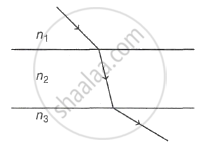
A beam of light passes from medium 1 to medium 2 to medium 3 as shown in the diagram. What may be concluded about the three refractive indices n1, n2 and n3?