Advertisements
Advertisements
Question
Answer the following question in your own words.
Describe the structure of the DNA molecule.
Advertisements
Solution
- All organisms have the same DNA structure. Watson and Crick modelled DNA in 1953. In this model, two parallel nucleotide threads coil around each other. A ‘double helix’ describes this arrangement. Like a coiled ladder, its construction is flexible.
- The DNA strands include many tiny ‘nucleotide’ molecules. Four nitrogenous bases are adenine, guanine, cytosine, and thymine. Cytosine and thymine are pyrimidines and adenine and guanine are purines.
- A nitrogenous base, phosphoric acid, and sugar molecule form the nucleotide.
- Four types of nitrogenous bases equal four types of nucleotides.
- DNA has a chain of nucleotides. Each ladder rail is constructed of alternately connected sugar and phosphoric acid molecules, like the DNA molecule's two threads. Every ladder step is two nitrogenous bases connected by hydrogen bonds. Adenine always connects with thymine, cytosine with guanine.

Structure of DNA

DNA (Watson and Crick’s Model)
APPEARS IN
RELATED QUESTIONS
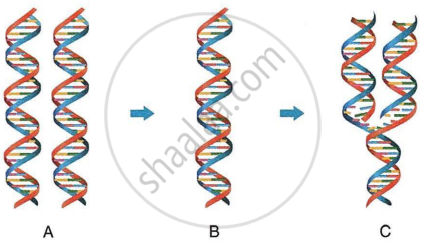
The three sketch (A, B and C) are intended to represent the replication of DNA.
What should be their correct sequence, starting with the first and ending with the last? ……
Fill in the blank:
DNA replicates in the ______ of the cell cycle.
Choose the correct answer:
Sex chromosomes in man are _____________
Complete the following sentence with appropriate word:
A chromosome is composed of 50 % DNA and 50% ________.
Multiple Choice Question:
In the RNA molecule, which nitrogen base is found in place of thymine?
New nucleotides are added and a new complementary strand of DNA is formed with the help of enzyme DNA polymerase.
Down’s syndrome is a genetic condition with 45 chromosomes.
Name the bond which binds the nucleotides in a DNA.
In glycolysis how many NADH molecules are produced during the conversion of one glucose molecule to yield two molecules of pyruvate?
A nucleotide consists of three distinct components. Which of the following correctly identifies all three?
Which nitrogenous bases are classified as pyrimidines, characterized by their single-ringed structure?
How many hydrogen bonds link guanine and cytosine in the DNA double helix?
What is the pitch (vertical rise per complete turn) of the DNA double helix?
Which forces allow for temporary strand separation during DNA replication and transcription?
Base stacking interactions in the DNA double helix are primarily of what nature?
Bacteriophage φX174 is notable for having one of the smallest known viral genomes. Approximately how many nucleotides does it contain?
