Advertisements
Advertisements
Question
Answer the following question.
Explain the secondary structure of a protein with examples.
Answer in Brief
Advertisements
Solution
- There are two types of the secondary structures of protein: α-helix and β-pleated sheets.
- The polypeptide chain is arranged in a spiral helix. These spiral helices are of two types: α-helix (right-handed) and β-helix (left-handed).
- This spiral configuration is held together by hydrogen bonds.
- The sequence of amino acids in the polypeptide chain determines the location of its bend or fold and the position of formation of hydrogen bonds between different portions of the chain or between different chains. Thus, peptide chains form an α-helix structure.
- Example of α-helix structure is keratin.
- In some proteins two or more peptide chains are linked together by intermolecular hydrogen bonds. Such structures are called β-pleated sheets.
- Example of a β-pleated sheet is silk fibres.
- Due to the formation of hydrogen bonds peptide chains assume a secondary structure.
shaalaa.com
Biomolecules in the Cell
Is there an error in this question or solution?
APPEARS IN
RELATED QUESTIONS
Answer the following question.
How many types of polysaccharides you know?
Answer the following question.
Explain the induced fit model for the mode of enzyme action.
Answer the following with reference to the following figure.
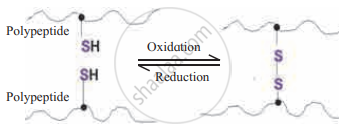
- Name the type of bond formed between two polypeptides.
- Which amino acid is involved in the formation of such bond?
- Amongst I, II, III and IV structural level of protein, which level of structure includes such bond?
Explain the biomolecules building blocks of life.
Long answer question.
What are enzymes?
Long answer question.
Describe the models for enzyme actions.
Long answer question.
Describe the factors affecting enzyme action.
Long answer question.
What are the nucleic acids?
Name the form in which carbohydrate is transported in a plant.
The most abundant molecule in cell is ______.
