Advertisements
Advertisements
Question
Answer the following in short.
What are derived physical quantities? Give any two examples of derived physical quantities.
Advertisements
Solution
Physical quantities that are derived from one or more fundamental physical quantities are called derived physical quantities.
Examples: area, volume, speed, density, etc.
APPEARS IN
RELATED QUESTIONS
Arrange the following substances in order of their increasing density:
(a) iron
(b) cork
(c) brass
(d) water
(e) mercury
The length, breadth and height of a water tank are 5 m, 2.5 m and 1.25 m, respectively. Calculate the capacity of the water tank in (a) m3 (b) litre.
How long a train will take to travel a distance of 200 km with a speed of 60 km h-1 ?
Express 15 m s-1 in km h-1.
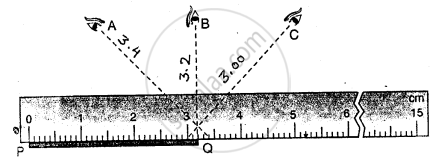
The diagram below shows a stick placed along a metre RULER. The length of the stick is measured keeping the eye at positions A, B, and C.
Express in second:
5 hour 2 minute 5 second.
Tick the most appropriate answer.
Which of the following is a fundamental physical quantity?
Answer the following in detail.
which is the most suitable unit for measuring the volume of a glass filled with water?
Give a reason for the following.
Measuring units are standardized.
Your friend was absent from school yesterday. You are enquiring about his absence. He told that he had a fever and it was measured to be 100oC. Is it possible to have a 100oC fever? If he is wrong, try to make him understand.
