Advertisements
Advertisements
Questions
Answer in brief:
Explain what is the optical path length. How is it different from actual path length?
What is Optical Path length? How is it different from the actual Path length?
Advertisements
Solution 1
Consider, a light wave with an angular frequency of w and a wave vector of k travelling in the x-direction through a vacuum. The phase of this wave is (kx - ωt). In a vacuum, light speed at c, but in a medium, it speeds at v.
k = `(2pi)/lambda = (2pi v)/(v lambda) = omega/v` as ω = 2πv and v = vλ, where v is the frequency of light.
If the wave travels a distance Δ x, its phase changes by Δ Φ = kΔx = ω Δx/v.
Similarly, if the wave is travelling in vacuum,
k = ω/c and Δ Φ = ω Δ x/c
Now, consider a wave travelling a distance Δ x in the medium, the phase difference generated is,
Δ Φ' = k' Δ x = ωn Δ x/c = ω Δ x'/c ...(1)
where Δ x' = n Δ x .....(2)
The distance nΔ x is called the optical path length of the light in the medium; it is the distance the light would have travelled in the same time t in vacuum (with the speed c).
The optical path length in a medium is the corresponding path in a vacuum that light traverses at the same time as it does in the medium.
Now, speed = `"distance"/"time"`
∴ time = `"distance"/"speed"`
∴ t = `"d"_"medium"/"v"_"medium" = "d"_"vaccum"/"v"_"vaccum"`
Hence, the optical path = `"d"_"vacuum"`
`= "v"_"vaccum"/"v"_"medium" xx "d"_"medium"`
`= "n" xx "d"_"medium"`
Thus, a distance d travelled in a medium of refractive index n introduces a path difference = nd - d = d (n - 1) over a ray travelling equal distance through vacuum.
Solution 2
i. When a wave travels a distance Δx through a medium having a refractive index of n, its phase changes by the same amount as it would if the wave had travelled a distance nΔx in a vacuum.
ii. Thus, a path length of Δx in a medium of refractive index n is equivalent to a path length of nΔx in a vacuum.
iii. nΔx is called the optical path travelled by a wave.
iv. This means, the optical path through a medium is the effective path travelled by light in a vacuum to generate the same phase difference.
v. Optical path in a medium can also be defined as the corresponding path in a vacuum that the light travels at the same time as it takes in the given medium.
i.e., time = `"d"_"medium"/"v"_"medium" = "d"_"vacuum"/"v"_"vacuum"`
∴ `"d"_"vacuum" = "v"_"vacuum"/"v"_"medium" xx "d"_"medium" = "n" xx "d"_"medium"`
But `"d"_"vacuum"` = Optical path
∴ Optical path = n × `"d"_"medium"`
Thus, a distance d travelled in a medium of refractive index n introduces a path difference = nd - d = d(n - 1) over a ray travelling an equal distance through the vacuum.
RELATED QUESTIONS
Write the important characteristic features by which the interference can be distinguished from the observed diffraction pattern.
Write the necessary conditions to obtain sustained interference fringes.
How does the angular separation between fringes in single-slit diffraction experiment change when the distance of separation between the slit screens is doubled?
What is meant by coherent sources?
Answer in brief:
In Young's double-slit experiment what will we observe on the screen when white light is incident on the slits but one slit is covered with a red filter and the other with a violet filter? Give reasons for your answer.
What are coherent sources of light?
What is phase of a wave?
Obtain the equation for bandwidth in Young’s double slit experiment.
Discuss the interference in thin films and obtain the equations for constructive and destructive interference for transmitted and reflected light.
Two independent monochromatic sources cannot act as coherent sources, why?
In Young's double-slit experiment, if the width of the 2nd bright fringe is 4 x 10⁻² cm, then the width of the 4th bright fringe will be ______ cm.
In Young's double slit experiment green light is incident on the two slits. The interference pattern is observed on a screen. Which one of the following changes would cause the observed fringes to be more closely spaced?
If the monochromatic source in Young's double slit experiment is white light, then ____________.
In a Young's double-slit experiment, the intensity at a point where the path difference is `lambda/3` (`lambda` being the wavelength of the light used) is I. If I0 denotes the maximum intensity, then `"I"/"I"_0` is equal to ______.
In a biprism experiment, D = 1 m, `lambda` = 6000 Å. When a convex lens is interposed between the biprism ru1d the eyepiece, then the distance between the images of the slits given by the Jens at two positions are 1.5 mm and 6.0 mm. The fringe width will be ______.
In Young's double slit experiment with a source of light of wavelength 5860 Å, the first maxima will occur when ____________.
In interference experiment, intensity at a point is `(1/4)^"th"` of the maximum intensity. The angular position of this point is at (sin30° = cos60° = 0.5, `lambda` = wavelength of light, d = slit width) ____________.
Two coherent light sources of intensity ratio 'n' are employed in an interference experiment. The ratio of the intensities of the maxima and minima in the interference pattern is (I1 > I2).
If two waves represented by `"y"_1 = 3 "sin" omega "t"` and `"y"_2 = 5 "sin" (omega "t" + pi/3)` interfere at a point, then the amplitude of the resulting wave will be about ____________.
In biprism experiment, if the 5th bright band with wavelength 'λ1' coincides with the 6th dark band with wavelength 'λ2' then the ratio `(lambda_2/lambda_1)` is ______
In the biprism experiment, a source of monochromatic light is used for a certain distance between slit and eyepiece. When the distance between two virtual sources is changed from dA to dB, then the fringe width is changed from ZA to ZB. The ratio ZA to ZB is ______
Light waves from two coherent sources arrive at two points on a screen with a path difference of zero and λ/2. The ratio of the intensities at the points is ______
Young's double slit experiment is performed in water, instead of air, then fringe width ______.
Two coherent sources of intensities I1 and I2 produce an interference pattern on the screen. The maximum intensity in the interference pattern is ______
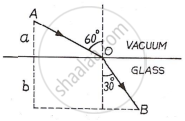
A ray of light AO in a vacuum is incident on a glass slab at an angle of 60° and refracted at an angle of 30° along OB as shown in the figure. The optical path length of the light ray from A to B is ______.
In biprism experiment, the distance of 20th bright band from the central bright band is 1.2 cm. Without changing the experimental set-up, the distance of 30th bright band from the central bright band will be ______.
