Advertisements
Advertisements
Question
Answer in brief:
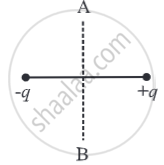
A charge q is moved from a point A above a dipole of dipole moment p to a point B below the dipole in an equatorial plane without acceleration. Find the work done in this process.
Advertisements
Solution
The equatorial plane of an electric dipole is an equipotential with V = 0. Thus, moving a charge between two points in a dipole's equatorial plane requires no work.
APPEARS IN
RELATED QUESTIONS
Three charges –q, +Q, and –q are placed at equal distances on a straight line. If the potential energy of the system of the three charges is zero, then what is the ratio of Q: q?
A dipole with its charges, −q and + q located at the points (0, −b, 0) and (0, +b, 0) is present in a uniform electric field E. The equipotential surfaces of this field are planes parallel to the yz plane.
- What is the direction of the electric field E?
- How much torque would the dipole experience in this field?
Electric potential due to the system of charges is calculated using the principle of ______
Derive an expression for the electric potential at a point due to a short electric dipole. Hence, write the expression for the electric potential at a point (i) dipole axis and (ii) on the dipole equator.
The work done in bringing a unit positive charge from infinity to a given point against the direction of electric field is known as ______.
Electric potential at a point ‘P’ due to a point charge of 5 × 10⁻⁹ C is 50 V. The distance of ‘P’ from the point charge is ______.
(Assume, `1/(4piε_0)` = 9 × 10+9 Nm2 C−2)
The electrostatic potential due to an electric dipole at a distance ‘r’ varies as ______.
The electric potential at a point in an electric field is defined as:
A point charge \[+q\] is at the origin \[O\], and a unit positive test charge is placed at a distance \[x\] from \[O\]. The electrostatic force on this test charge acts:
The equipotential surfaces around an isolated point charge are:
A charge of \[4 \times 10^{-7}\ \text{C}\] is located 9 cm away from a point P. Taking \[\frac{1}{4\pi\varepsilon_0}=9 \times 10^9\ \text{N m}^2\text{C}^{-2}\], the electric potential at P is:
A charge of \[2 \times 10^{-9}\ \text{C}\] is brought from infinity to a point P where the potential is \[4 \times 10^4\ \text{V}\]. The work done in bringing this charge is:
A wire is bent into a circle of radius \[R = 10\ \text{cm}\] carrying a uniformly spread charge \[q = 250\ \mu\text{C}\]. The electric potential at the centre of the circle is:
The net potential due to several point charges at a point is found by simple algebraic addition of individual potentials because:
When a point charge \[+q\] is embedded in a medium of dielectric constant \[K\], the effective permittivity of the medium is:
In the derivation of the potential in a medium of dielectric constant \[K\), the total work done in bringing a unit positive test charge from infinity to distance \[r\) is:
